
Key Takeaways:
- RFID is a tracking input, not a complete yard operating system. It tells your team where and when an asset was detected, but it does not assign moves, manage dock flow, or resolve yard bottlenecks on its own.
- A YMS turns RFID location data into action by adding driver tasking, dock scheduling, detention tracking, compliance prompts, and exception-based workflows.
- The strongest yard strategy is software-first. Leading YMS systems often support RFID, barcode, GPS, manual updates, and other data inputs without forcing every facility to invest in expensive hardware before they are ready.
When spotters spend hours searching for trailers in the lot, your inventory lists get outdated fast.
These long manual walks slow down your whole operation. They drain team productivity, and you might even have to hire extra people just to keep trailers moving.
We recognize that RFID can be a helpful tool for gathering location data. When readers capture trailer data at specific points, the system can direct drivers to the right spot. This can reduce manual yard walks down to what is strictly needed for compliance and exceptions.
But even though RFID is useful for tracking where things are, is tracking data enough to run your entire yard?
What Is an RFID Yard Management System?
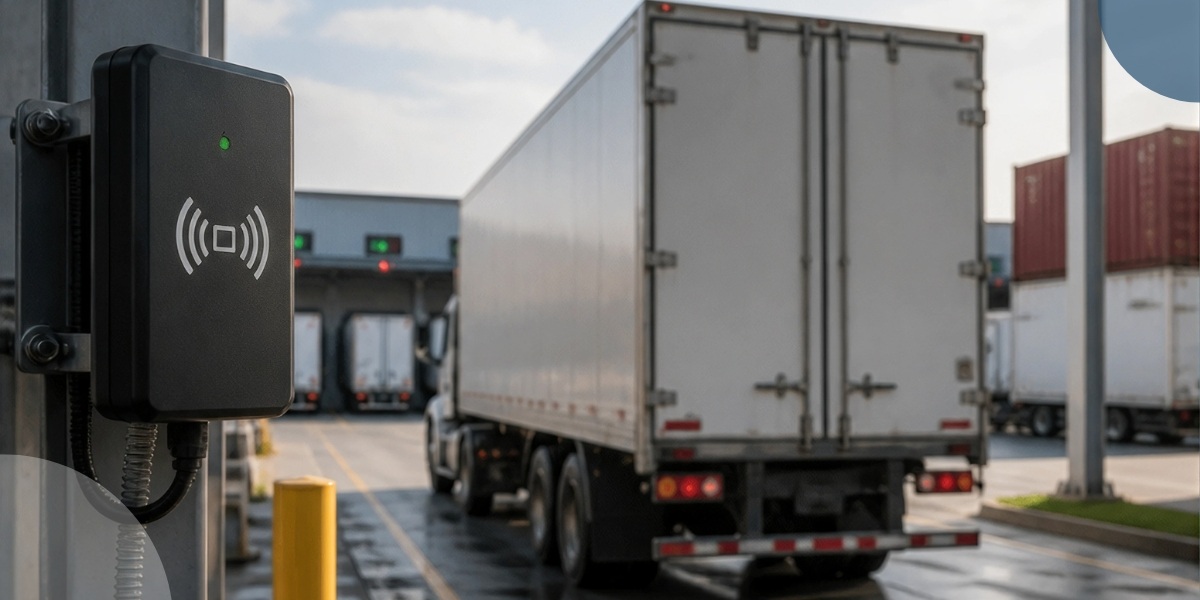
An RFID yard management system uses radio frequency identification tags. These tags attach to trailers and containers. These tags attach to trailers and containers to mark their location at fixed reader points.
RFID-based systems do not guarantee full yard visibility. Common issues include high adoption and maintenance costs. A less cumbersome barcode-based YMS often delivers higher ROI and fewer operational hurdles.
Each tag broadcasts a unique identifier when it passes a fixed reader at gates, dock doors, or zone boundaries. Software captures these reads and logs them as timestamped events.
You've likely encountered RFID in vendor pitches and equipment discussions. The technology tells you a trailer passed Gate 3 at 14:22 or reached Dock 7 at 09:45.
But RFIDs alone cannot manage your yard operations. They feed location data into a yard management system that turns it into everyday operational decisions.
Passive vs. Active RFID Tags
Passive tags cost less and work at gate readers where trailers pass within a few feet. Your team gets exact digital confirmation when assets cross fixed checkpoints.
Active tags cost more but track assets across a wider area of the yard. They let you pinpoint exact locations in open lots without requiring proximity to readers.
Common Technologies Used in Yard Management
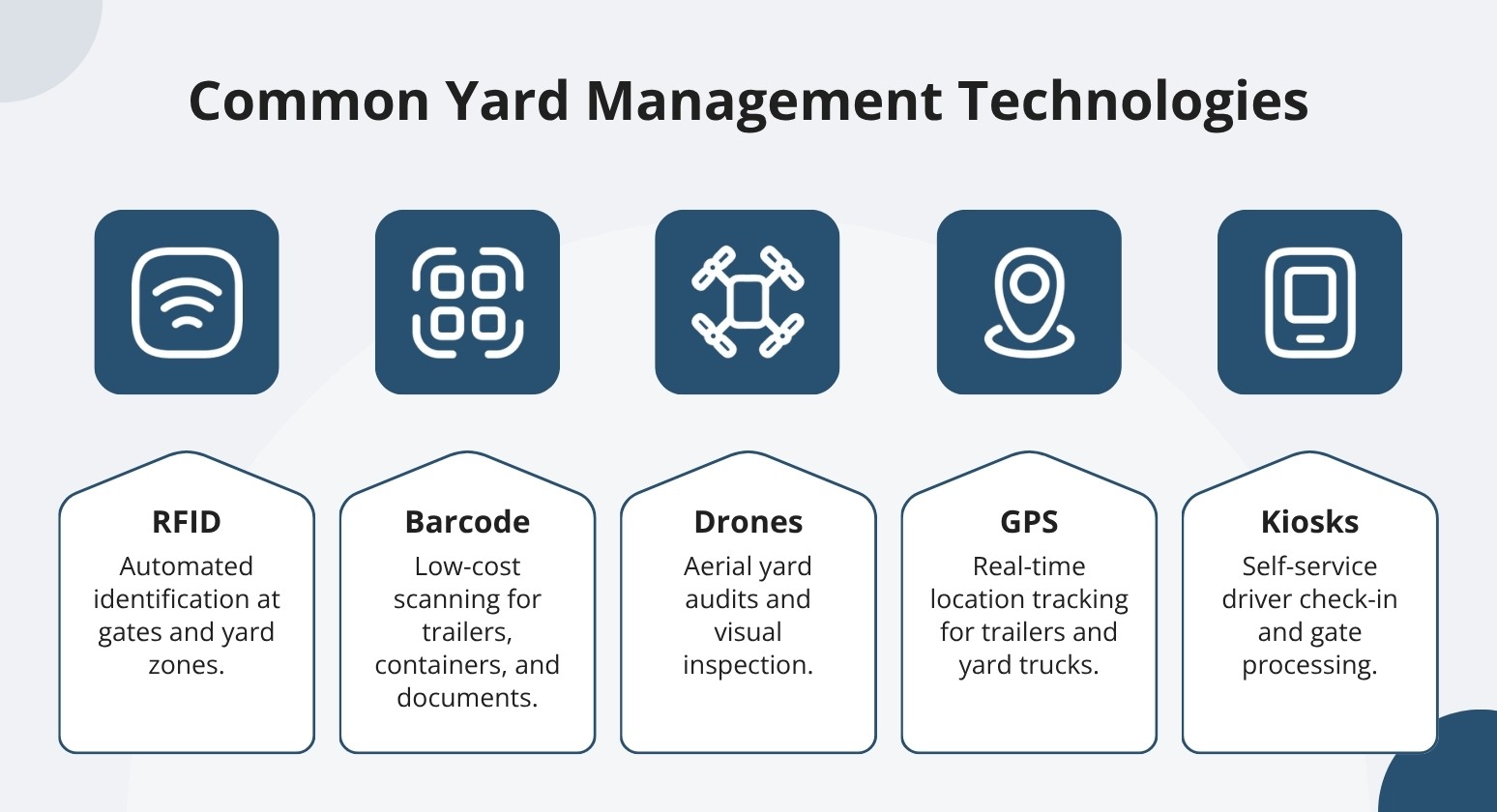
RFID, barcode scanning, drones, GPS tracking, and self-service kiosks are common technologies that feed data into yard management systems. A yard management system coordinates what they capture into prioritized driver tasks and operational decisions.
None of these technologies, standing alone, constitutes yard management; they add real value only when the software foundation directs how their data gets used. Hardware feeds the system. The YMS runs the yard.
- RFID for automated identification at gates and yard zones: RFID readers capture trailer and container IDs at gates and zone boundaries.
- Barcode scanning for trailers, containers, and documents: gate staff scan trailer placards, container labels, and arrival documents to auto-populate your gate log.
- Drones for aerial yard audits and visual inspection: Drones can provide aerial views for lot audits and asset verification in hard-to-reach areas; long-term operational value is still being established.
- GPS for real-time trailer and truck tracking: GPS gives dispatchers exact asset locations across large or unmarked lots in real time.
- Kiosks self-service driver check-in and gate processing: Kiosks eliminate manual check-in forms and route drivers to open yard locations; they can slow carrier and cargo confirmation at the gate and add unexpected cost.
How an RFID Yard Management System Works in Practice
RFID deployment follows a predictable sequence that starts with physical setup and ends with operational data.
RFID tags attach directly to trailers, containers, chassis, or other yard assets at strategic mounting points. Readers mount at gate lanes, dock doors, and zone boundaries. Coverage stays limited to those fixed points.
When a tagged trailer passes your gate reader, RFID captures the exact timestamp and asset ID without manual entry or radio calls. In-yard location updates depend on reader density. Assets are only detected where readers are installed.
A yard management system uses raw tag reads to trigger operational decisions. For example, a tag read at Gate 3 at 14:22 becomes a check-in update. Then the system can use that data to direct parking and start the next driver task.
Why an RFID-Only Approach Isn't a Yard Management System
RFID supports location tracking. It provides the data, but it does not direct yard workflows.
A tag read can tell you a trailer entered Gate 3 at 14:22. It cannot generate the next move assignment, direct a driver to Dock 12, or determine which of thirty trailers should move first. There’s no driver tasking, next-best-move logic, or in-cab workflow.
An RFID-only approach also lacks built-in dock scheduling, appointment management, detention and demurrage tracking, dispute documentation, and compliance support.
In addition, tags may fall off during wash rack cycles and at the loading dock. Metal surfaces can cause missed reads, and damaged readers can create blind spots until technicians can respond.
If your facility already deals with blind spots and gaps in visibility, RFID won’t solve the problem on its own. You need a standalone, purpose-built yard management system.
Implementation Considerations Before You Buy RFID
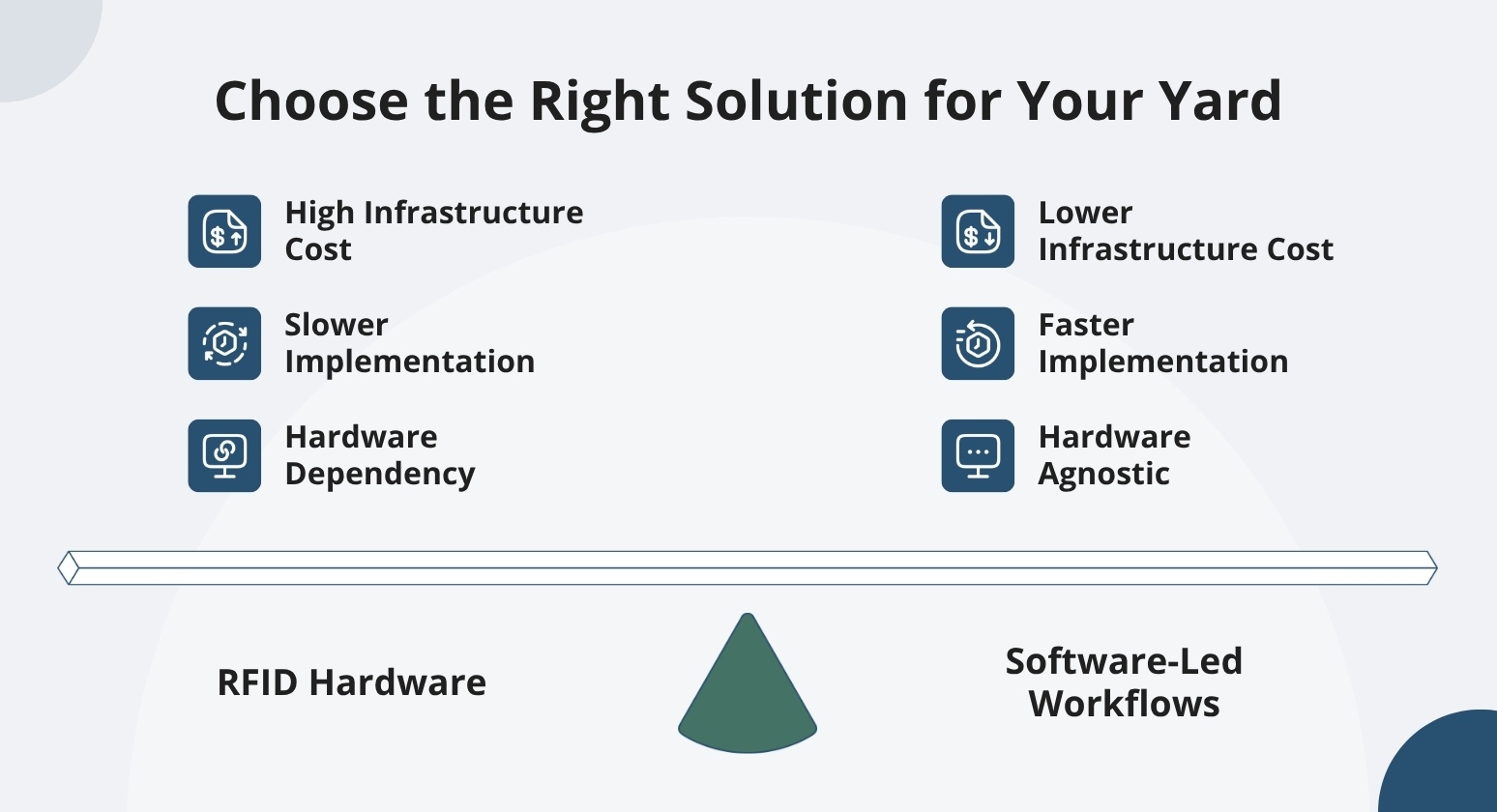
Before committing RFID infrastructure budget, ask whether your yard actually needs hardware to solve visibility problems. Most savings come from software that directs drivers and tracks assets.
- Assess whether RFID is worth the hardware investment: it may make financial sense for facilities with 8 or more gate lanes where managing traffic across multiple points is challenging. Facilities with fewer gate lanes can often get the same visibility using QR codes or barcode scanning at a fraction of the cost.
- Avoid rip-and-replace: YardView runs on your existing PCs, tablets, phones, and in-cab devices with no additional proprietary hardware required. SMS-based driver communication means no app download needed.
- Select a YMS that supports RFID without requiring it: YardView connects to existing RFID readers via API, integrates with barcode scanners, and syncs with GPS systems, protecting you from vendor lock-in and hardware upgrade cycles.
- Start with software, not hardware: In YardView’s phased rollout approach, Phase 1 mirrors your existing processes into the platform without disruption; Phase 2 connects your WMS and TMS for real-time tracking and automated tasking; Phase 3 evaluates where RFID or GPS adds cost-effective value on top of the working system.
Opt Out Of The RFID Visibility Gap with YardView
YardView reduces the time spent on manual yard walks and ends the endless hunt for trailers. It gives your team real-time yard visibility, showing them exactly where assets are and what needs to move next.
- Lot check and yard audit tools that allow drivers to verify, update, and correct asset positions from the in-cab device, making digital verification up to 75% faster than traditional manual lot walks.
- Drag-and-drop yard console displaying up to 20 data points per asset across all docks, spots, lanes, and zones in a single live view
- In-cab move request system with Next-Best-Move tasking and an Accept → Start → Finish workflow that ends the radio-and-search cycle, eating spotter hours
- Barcode, RFID, and GPS integration supported, giving you the flexibility to add tracking hardware whenever your lot needs it.
- Directed parking and guided move assignments that route drivers to the exact asset location immediately, cutting spot move time in half based on customer-reported outcomes
See how YardView delivers this operational visibility without the infrastructure overhead.
FAQs:
What Is the Purpose of a Yard Management System?
A YMS replaces manual yard tracking. It gives real-time visibility and workflow automation. This covers gate, yard, and dock operations.
It shows which dock doors are busy. Dispatchers can redirect drivers right away. It cuts manual gate check-ins. It cuts dock assignment time from hours to minutes.
You get better throughput. The platform automatically captures operational data for compliance reporting.
How Long Does YMS Implementation Take?
Most YardView implementations take six weeks or less. Your yard stays operational throughout the rollout using a phased approach that eliminates disruption.
Phase 1 mirrors your existing processes in the web-based system while your team learns the interface. Phase 2 adds system integrations. Phase 3 introduces optimization features.
Each phase builds on the last without stopping daily operations.
Do I Need Special Hardware to Run a YMS?
No. A modern YMS runs on your existing PCs, tablets, phones, and in-cab devices — no additional proprietary hardware required. You can also leverage existing GPS in yard trucks for location tracking.
The system connects to what you already have. So setup focuses on workflow improvement rather than hardware setup.
How many gate staff can automation replace?
It depends on how far you take it. Touchless and unmanned entry through QR codes, kiosks, and smart cameras lets drivers check in without a person at the gate. In practice, that turns a full-time gate post into light exception handling and frees administrative hours per week that gate teams spend on manual check-in. Most facilities redeploy rather than cut, moving former gate staff to yard direction, safety, and exception handling instead of eliminating the role outright.
What happens if a guard calls in sick?
In a staffed-gate model, a single absence exposes how fragile coverage is. Check-in slows, driver lines build, and someone has to cover the post or the gate stalls. Touchless entry removes that dependency. With QR check-in, kiosks, and camera-based verification, drivers keep processing and receiving dock assignments even when no one is in the shack, while your team monitors remotely and steps in only for exceptions.
What is best-in-class gate turnaround time?
Well-run gates target a check-in transaction of roughly 5 to 15 minutes per truck, while manual gates often take 30 to 60 minutes when arrivals are unscheduled. This is the gate transaction itself, not the full gate-in-to-gate-out turnaround, which is a larger number. The value of tracking it lies in spotting outliers and shift-over-shift drift, not just hitting an average.
Can digital check-in create ASNs automatically?
YardView works with advance shipping notices as part of its integrations. When your TMS or WMS sends an ASN, YardView reads it to auto-populate the appointment and match the load to the driver at check-in, so the gate already knows what is arriving and when.
What is a good trailer dwell time?
There is no universal benchmark, and it helps to distinguish between driver dwell time at a shipping or receiving stop and other forms of facility or yard delay. For driver dwell time, load and unload waits typically range from two to three and a half hours, and ATRI data shows that roughly one in ten stops exceed two hours. Yard dwell, how long a trailer sits in your yard, should be driven down to hours rather than days, since multi-day dwell is a clear sign of inefficiency. What matters more than any single target is the trend: dwell should be predictable and falling, not spiking with volume.
How many moves per jockey per shift is normal?
As a rough rule of thumb, a yard hostler completes somewhere around 15 to 35 trailer moves per shift, though the real number swings widely with yard size, move distances, dock coordination, and equipment. The point of measuring it is to expose wasted trips and idle time rather than to hit a single figure. When the system directs each driver to the next best move through a simple in-cab accept, start, and finish workflow, drivers stop hunting for trailers and complete more moves per shift without adding headcount.
How Is True Real-Time Visibility Achieved Without Relying Solely on RFID?
Real-time visibility comes from multiple inputs working together.
Gate reads capture arrivals and departures. In-cab driver updates confirm moves and spot changes. Lot check tools let your drivers verify and correct asset positions from their devices. Integration data synchronizes with your WMS and TMS.
The lot check function replaces RFID dependency with software-driven verification. This happens as drivers work.

.webp)