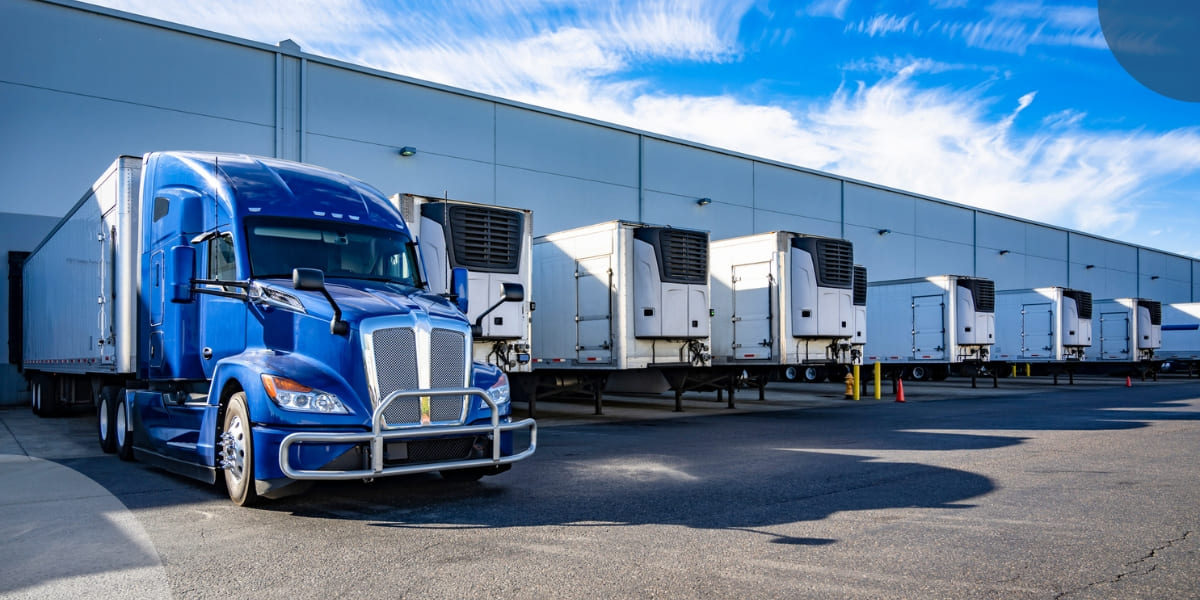
Your radio crackles with three move requests while yesterday's yard walk sits unfinished on your clipboard. The detention invoice on your desk shows $240 you never saw coming — another container that sat 72 hours without anyone catching it.
This is where margin disappears.
The gap between your TMS tracking inbound freight and your WMS managing inventory flow creates blind spots that drain your transportation budget. Learn how to close that gap and take control back with purpose-built yard and dock management systems.
What Is Dock and Yard Management?
Dock and yard management includes systems, processes, and technology. These control trailer movement between the gate and the dock door.
Many facilities address these needs by utilizing a combination of tools. They use yard management systems for trailer tracking. They use dock scheduling platforms for appointment coordination.
Yard Management: Controlling What Happens Outside the Building
Yard management is the discipline of tracking, tasking, and moving trailer assets across the physical yard.
With yard management, you can control everything from gate entry through dock assignment. This means you can know exactly where each trailer sits, what needs to move next, and who's available to move it.
The discipline turns on three decisions. Where to spot an incoming trailer. Which asset to prioritize for the next move. How to task drivers without radio chaos.
Dock Scheduling: Controlling What Hits the Door
Dock scheduling manages when carriers arrive, which doors they use, and how inbound and outbound appointments get sequenced across your facility. This allows for better control of space by time slot and door type. Using these tools, you can fix gate traffic by spreading arrivals across the day instead of letting them stack up at shift change.
The system shows door utilization by hour and flags scheduling gaps before they create bottlenecks. You can see which appointments are running late and which doors sit idle. Carriers get confirmed time slots instead of showing up and hoping for space.
Integration Across Gate, Yard, and Dock
The value of each capability multiplies when the gate, yard, and dock share a single system of record. Siloed tools create the same blind spots that disconnected manual processes do. Your gate data means nothing if it doesn't update yard inventory. Yard position is useless if it doesn't feed dock readiness.
Without unified data flow, you would still be running three separate operations that don’t talk to each other.
Do You Need Dock Scheduling, Yard Management, or Both?
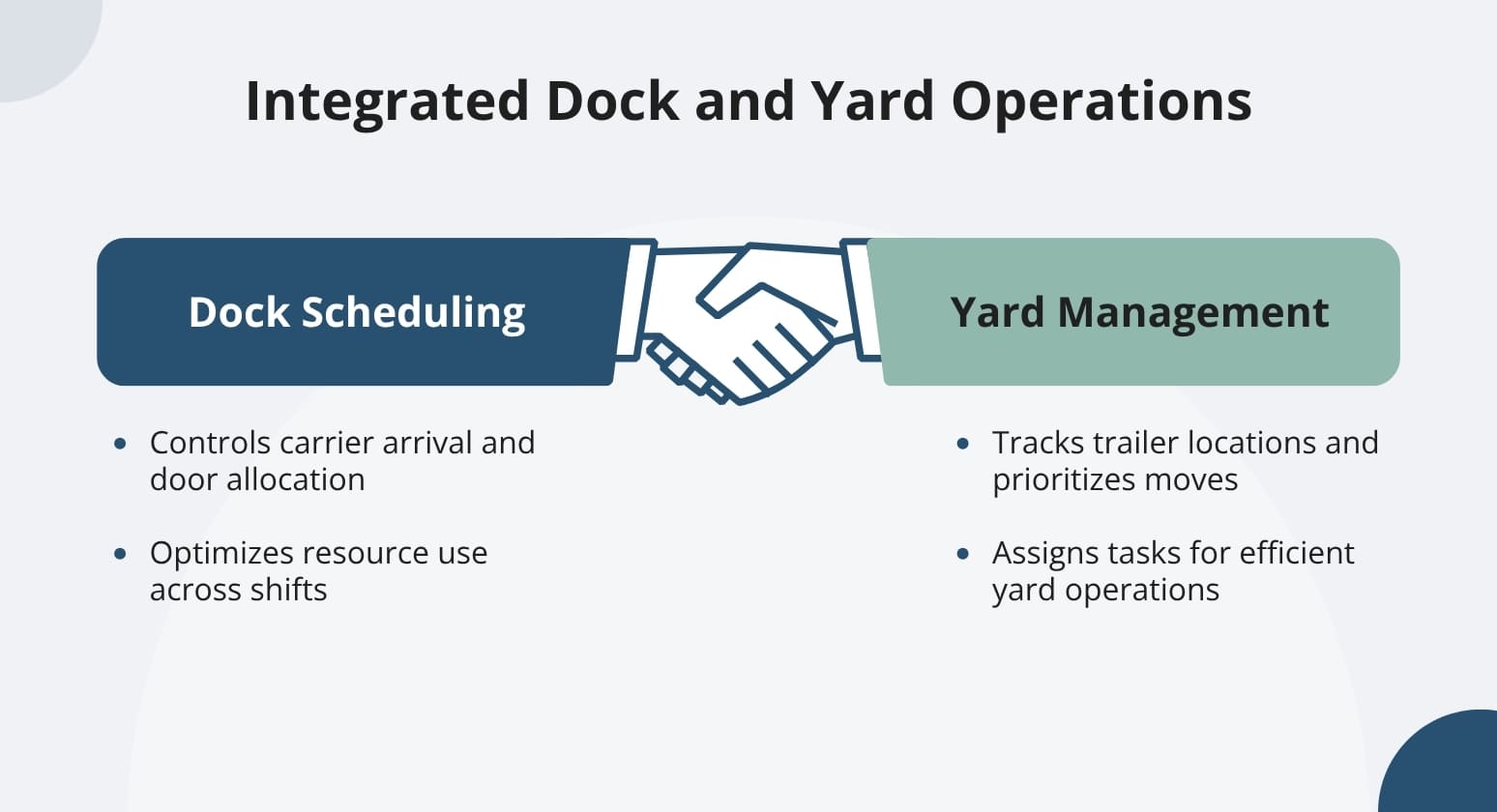
Every facility has unique needs. For some, the first step is fixing appointment scheduling, while for others, the priority is yard management. While you can start with either, a single platform that connects both may be the most effective approach.
Use the scenarios below to help identify which area of your operation needs attention first.
You Need Standalone Dock Scheduling
Your carriers stack up at the gate during shift change. You have no control over when appointments hit. Some doors run hot all morning while others sit idle. You can't spread inbound volume across the day because there's no system enforcing time slots.
But once trailers are inside your fence, you know where they are. Your yard is small enough, or simple enough, that visibility isn't the issue. You're not losing trailers. You're not getting blindsided by detention.
The problem is arrival flow, not asset tracking.
If this is you, dock scheduling closes the gap. With it, you can control capacity by door and time slot. Carriers self-schedule against live availability. Gate congestion drops because arrivals are sequenced, not stacked.
You Need Standalone Yard Management
Trailers disappear once they're past the gate. Detention invoices arrive for units you didn't know were sitting. Your leased pool keeps growing because nobody can tell you which trailers are active and which are dead weight.
Dispatch runs on radio calls and spreadsheets. Your team spends hours every shift walking the yard to figure out what's where.
But your inbound appointment flow is already handled. You have a scheduling tool that works, or your volume is steady enough that arrival timing isn't the main bottleneck. Trucks arrive when they're supposed to.
The problem starts after that.
If this is you, yard management recovers the visibility and control you're missing. It provides, real-time trailer location, dwell tracking before detention triggers, and prioritized move tasking instead of radio chaos.
You Need Both, Integrated
You may already have scheduling and yard tools, they just don't talk to each other.
- Gate arrivals don't update yard inventory.
- Yard position changes don't feed dock readiness.
- Your warehouse team finds out a load is staged when the trailer appears at the door, not before.
You're running three separate operations (gate, yard, dock) that should be one workflow. Since the data is often siloed, handoffs rely on phone calls, radios, and emails. Every gap in that operational data is where dwell costs accumulate and accountability disappears.
Even at a single site, siloed data makes handoffs difficult. When gate, yard, and dock teams don't share information, accountability disappears. These problems intensify as you scale; across ten sites, those data gaps can multiply into major financial leaks.
What Happens When Your Yard and Dock Become Financial Blind Spots?
Financial leaks come from three distinct places: the gate, the yard, and the gap between them. Most facilities can't tell which inefficiencies create the highest costs because the data remains spread across different systems, and nobody analyzes all the data together.
Use this section to identify the hidden costs in the areas you identified above.
Costs From Gate and Appointment Flow Problems
Carriers waiting at your gate burn driver hours that come back as detention charges. Doors sit idle while others overflow, killing throughput and forcing overtime to catch up. Missed appointment windows trigger carrier penalties you didn't budget for.
When auditors ask for arrival timestamps and you can't produce them, you fail the audit regardless of how well your operation actually ran. The records have to exist in a system, not on a clipboard.
These costs concentrate at shift change and during seasonal volume spikes. If your gate is the bottleneck, this is where your budget bleeds first.
Costs From Yard Visibility Problems
Detention and demurrage accrue on trailers nobody is tracking. A container sits 72 hours past its window and you find out two weeks later on an invoice. YardView’s customer-reported results show up to 95% D&D reduction is recoverable once visibility kicks in.
Customer audits fail when manual logs have gaps. The yard walk you didn't finish yesterday is the evidence you can't produce today.
Costs From the Integration Gap
This is the category most facilities don't price correctly because it does not show up as a line item.
Warehouse labor sits idle because nobody told them what was staged. Drivers wait at the dock because yard moves didn't update readiness. Your team enters the same data three times (once at the gate, once in the yard log, once in the dock schedule). Month-end reconciliation eats days because gate logs, yard inventory, and dock activity have to be manually matched.
A dock assignment gets made for a trailer that's already left. Every gap between systems is where accountability disappears and dwell costs accumulate.
Compliance and Audit Exposure
Audit failures cost you regardless of the specific regulation. If you can't produce timestamped records of arrivals, dwell, temperature events, or chain-of-custody on demand, you fail.
The exposure varies by industry and geography (food safety, emissions reporting, customer SLA audits) but the root cause is the same. Data scattered across systems that don't talk produces records nobody can defend.
The Benefits of Standalone and Integrated Dock and Yard Management
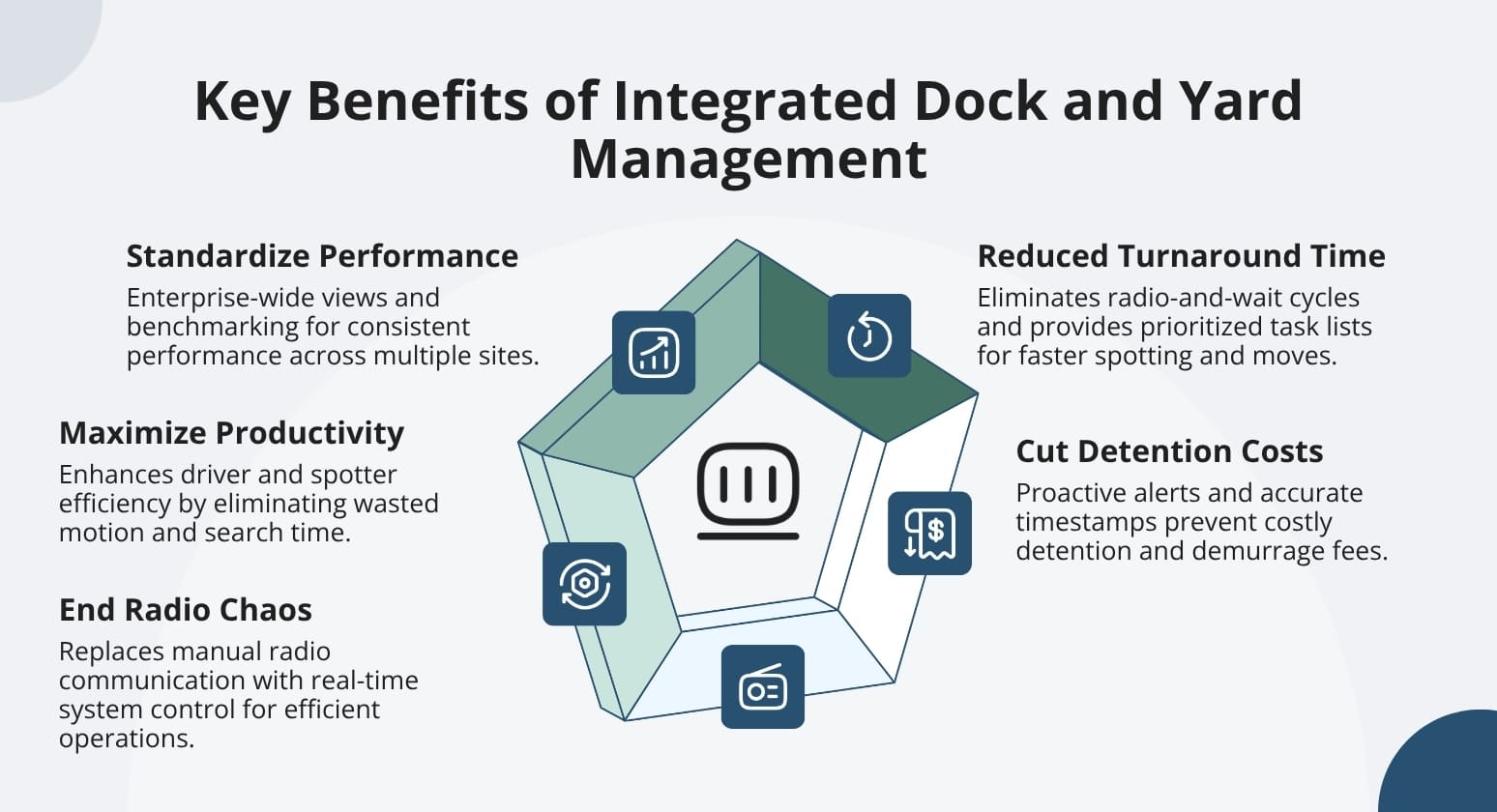
A yard management system solves some operational problems, while dock scheduling handles others. The key question is whether you're solving a single process issue or a connected yard-to-dock flow issue that works best when both are coordinated.
- What yard management delivers: A YMS recovers visibility and control inside your fence — with customer-reported results showing 50% faster spotting, yard audits running 75% faster, and D&D exposure dropping as dwell tracking flags trailers before fees trigger.
- What dock scheduling delivers: A scheduling tool controls when carriers arrive and which doors they use — carriers self-schedule against confirmed time slots, gate stacking at shift change disappears, and doors stop running hot-and-cold because volume gets sequenced across the day.
What Only Integration Delivers
Integration earns its price when the gate, yard, and dock share one system of record. The benefits below need the data to flow across all three.
- Gate arrivals auto-update yard inventory. The moment a trailer crosses the geofence or scans in, it appears on the yard board with carrier, load, and appointment context attached — no manual entry, no radio calls asking whether a truck checked in.
- Yard position feeds dock readiness in real time. Warehouse teams see what's staged before the trailer hits the door. They prep labor, equipment, and paperwork against trailers that are 20 minutes away, not 20 seconds away. Dock dwell drops because the warehouse stops being blind to what's coming.
- Appointments generate gate passes, which trigger yard tasks. The carrier's confirmed slot becomes a gate credential, which becomes a yard move, which becomes a dock assignment. One thread instead of three handoffs. Every step is documented and timestamped automatically.
- Detention math runs across the full window. Only a unified platform measures from scheduled appointment to actual departure. That's the number that holds up when you dispute a detention charge — or when you bill one to a carrier who blew their window.
- Multi-site standardization works. Network-wide KPIs — dock turn time, driver productivity, D&D exposure — roll up cleanly because the data structure is the same at every site.
Standalone products solve point problems. A unified platform solves the handoff problem.
At one facility, the handoff problem is manageable since your team papers over it with radio calls and good habits.
At 10 facilities, the handoffs multiply faster than the headcount can absorb. That's where margin disappears at scale, and that's the gap a unified system is built to close.
Run Your Gate, Yard, and Dock as One Operation With YardView
YardView connects your gate, yard, and dock into a single system of record, eliminating the handoffs where dwell costs accumulate and accountability disappears.
- YardView's drag-and-drop console displays up to 16 data points per asset across all docks, spots, lanes, and waiting zones
- Detention & Demurrage module tracks dwell in real time, sends proactive alerts before fees trigger, and creates timestamped dispute evidence when carriers overcharge
- Dock scheduling module lets carriers self-schedule against live availability while capturing post-arrival dwell automatically
- In-cab move request system delivers prioritized next-best-move recommendations through a simple Accept → Start → Finish workflow
- REST API, SOAP API, flat file, and EDI integration connect to your existing WMS, TMS, or ERP in as few as 10 integration hours
Explore YardView in action and see how you can run a fully coordinated, real-time yard operation.
FAQs:
What Is the Difference Between a WMS and a YMS?
A warehouse management system manages inventory and operations inside the building. A yard management system manages trailer assets, driver tasks, and gate-to-dock flow outside it. They're complementary, not interchangeable.
Your WMS tracks pallets on the warehouse floor. Your YMS tracks trailers in yard spots and dock assignments. The gap between them is where dwell costs accumulate. Trailers sit unaccounted for between the gate and the dock while neither system tracks what's happening.
What Are the Key Features of a Dock Management System?
A dock management system schedules and coordinates inbound and outbound appointments, assigns carriers to specific doors, and tracks arrival timing. You know which doors are open and which carriers are inbound. The system manages capacity rules and time slots to prevent congestion.
Dock management delivers its highest value when connected to live yard data. Real-time yard position feeds dock readiness so warehouse teams know what's staged before it hits the door.
How Long Does Yard Management Implementation Take Across Multiple Facilities?
YardView deploys in 6 weeks per site using a phased rollout model. Phase 1 goes live without disrupting your current yard operations. Leadership sees measurable results before full integration is complete.
YardView currently manages 110,000+ yard moves monthly across enterprise networks. Your team experiences the same proven deployment process at each facility.
Do We Need New Hardware or Proprietary Devices?
No. YardView runs on your existing PCs, tablets, phones, and in-cab devices. The platform can leverage existing GPS systems in yard trucks without additional hardware purchases.
The web platform connects to devices your team uses. It works with your current daily operations.

%20(1).png)