

Your phone rings at 7:15 AM: a carrier wants to schedule for today. Two emails sit in the shared inbox from yesterday's arrivals you never confirmed. A truck pulls up to the gate with no appointment, and the line starts forming behind the truck before your gate agent can react.
Good carrier appointment management reclaims control over your yard operations. It replaces reactive issue management. It uses systematic and proactive yard control.
Why Appointment Management for Carriers Is a P&L and Not a Scheduling Problem
Poor appointment management hits your P&L in three places: detention fees, idle assets, and administrative overhead that you can't see until the invoices arrive.
Your gate backs up because carriers show up unannounced; trailers sit for days before anyone flags the dwell; and your Finance team pays detention charges they can't validate or dispute. The yard becomes a financial blind spot where money leaks out through uncoordinated arrivals and reactive problem-solving.
It’s important to remember that you're not just managing a calendar, you're controlling when costs accumulate and when assets turn productive. Fix the scheduling chaos, and the margin problem fixes itself.
What is Appointment Management for Carriers?
Carrier appointment management is the process of scheduling, confirming, and tracking when carriers arrive, which dock they use, and what happens after they check in.
This controls your gate flow, dock scheduling, and dwell time. Without it, carriers show up unannounced, your gate backs up, and trailers sit in spots while detention fees accumulate silently.
How Appointment Chaos Erodes Margin Across the Network
Each site relies on its own scheduling method — one on spreadsheets, another through email chains, a third on a legacy system. You can't benchmark performance when Site A tracks dwell differently from Site B. You can't roll out network standards when every location speaks a different language.
As a result, trailers sit unassigned across multiple facilities while dispatch burns hours coordinating between sites that don't share the same data. Appointment volumes, actual dwell times, and dock utilization rates stay invisible at the network level.
The Operational Pain Points of Manual Scheduling
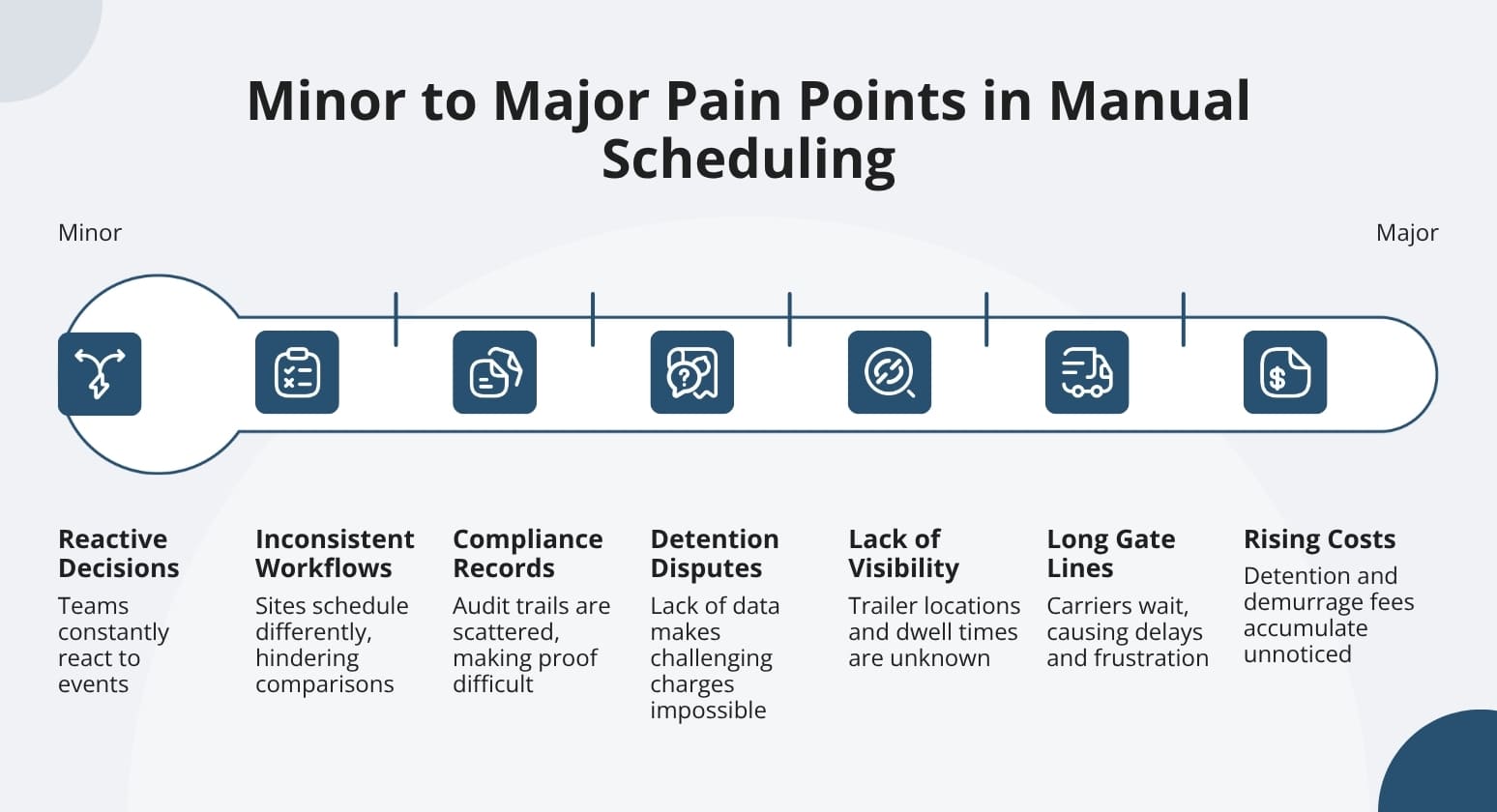
Manual scheduling tools force your team into a constant cycle of reactive decisions. You're managing appointments on spreadsheets that three people update simultaneously. Critical information lives in email threads that gate staff can't access. Radio calls interrupt every task, and drivers wait for directions that should have been automated hours ago.
Rising Costs
Manual scheduling turns your yard into a financial blind spot where detention fees at $30–$50/hour and demurrage up to $300/day accumulate without anyone knowing. You can't see dwell time per asset or track when a trailer crosses fee thresholds. A container may sit for three days before someone flags it.
The invoice arrives weeks later with charges you can't validate or dispute.
Compared to their previous carrier invoices, YardView customers commonly report up to 95% reduction in D&D fees by catching these situations before they cost money.
Long Gate Lines and OTR Drivers
Your gate team has no dock assignment to give when carriers arrive unscheduled. Drivers may sit in line for 30–60 minutes with nowhere to park. Your gate backs up because each arrival requires a phone call to dispatch.
OTR drivers idle their engines while your gate agent scrambles to find an open door. Your spotter gets pulled from actual moves to handle the queue. Therefore, gate processing time doubles when nobody knows what's coming next.
Lack of Visibility
A trailer sits in the wrong spot for three days before anyone notices. Dwell crosses your threshold on Tuesday afternoon, but you find out on Friday when the detention invoice lands on your desk. Most systems only show snapshots — where things are right now, not how long they've been there or what's about to cost you money.
YardView tracks trailers — before, during, and after each visit — triggering alerts before fees accumulate. You see a trailer that's been idle for 47 hours and can dispatch a driver before the 48-hour detention charge hits. This shift means catching problems while you can still do something about them.
Inconsistent Workflows Across Sites
When your network can't benchmark performance because each site schedules differently, you can't compare dock turn times across sites. Each location captures different data, and rolling out network standards becomes impossible.
Connecting sites to one scheduling platform eliminates the friction of mismatched data between locations. You can finally see which facility handles peak volumes best and why. Performance comparisons become meaningful, and the corporation can set network-wide carrier standards that actually stick because each location enforces them the same way.
Insufficient Compliance Records
Manual scheduling leaves you exposed when auditors arrive asking for proof. Scattered emails and spreadsheet entries don't constitute an audit trail. You can't prove which carrier arrived late or which dock had a gap in documentation when records are sampled or reconstructed after the fact.
YardView creates a complete audit trail. Every gate entry is timestamped. Every dock assignment is logged. Every departure is recorded with user attribution.
These timestamped records can help you resolve disputes with factual proof. You have documented evidence ready at any time. You can complete customer audits without scrambling.
The system captures the data needed for WAIRE rules. When connected to reefer and temperature data, it helps you meet FSMA chain-of-custody requirements. You have a complete digital history instead of incomplete manual logs.
Detention and Demurrage Disputes
You cannot dispute what you did not measure. When carriers bill detention or demurrage, your team needs exact timestamps and dwell data to challenge the charges.
YardView's dedicated D&D module captures real-time dwell tracking with automated arrival, dock, and departure timestamps. The system shows exactly how long each asset sat at your facility and what threshold triggered fees.
You can dispute carrier invoices with documented evidence instead of accepting charges you can't verify.
Key Features of an Appointment Management System for Carriers
The right appointment system eliminates manual scheduling chaos and puts you back in control of your yard. You can see which dock is occupied right now, catch dwell problems before they cost money, and stop fielding carrier status calls that pull your team off the floor.
Real-Time Visibility Across Gate, Yard, and Dock
Real-time visibility means you know which dock is occupied, how long each trailer has been sitting, and which carrier just arrived at your gate. Your operations team sees exact asset locations across the entire facility on one screen. When a trailer crosses the two-hour dwell threshold, you catch it before detention fees trigger.
Digital tracking shows you which doors are backing up and which lanes have capacity. You can reassign a late carrier to an open dock without walking the yard or making radio calls.
Carrier Self-Service Portals
Appointments can be created through four methods:
- ASN/TMS/WMS integration
- Carrier self-service portals with secure login credentials
- System-triggered events
- Manual creation by operations staff.
Carrier self-service portals let carriers book their own appointment slots based on real-time dock availability. Your team can then stop fielding scheduling calls and email chains.
Read-only carrier and customer portals surface appointment status, dock assignments, and estimated ready times. Carriers see which time slots are available and book directly. Your operations staff focuses on moving freight instead of answering status calls.
Automated Scheduling, Confirmations, and Notifications
A digital appointment system eliminates the phone tag between your operations team and carriers. When a carrier schedules an appointment, the system automatically sends confirmation emails that double as gate passes. Your gate staff no longer needs to call back to verify arrival times or manually create entry documents.
SMS notifications keep drivers informed throughout their visit without requiring calls to your dispatch. The system sends arrival confirmations, door assignment updates, and departure clearance directly to the driver's phone.
This removes manual status calls from your team's workload and keeps carriers moving without constant check-ins.
Integration With WMS, TMS, and ERP Systems
Your appointment system should work with the WMS, TMS, and ERP systems you already have running. YardView offers integration with several systems, including SAP, Oracle, Manhattan Associates, Blue Yonder, and Trimble.
With YardView, your dispatchers can stop re-entering the same load data twice. Your dock coordinators see appointment details without jumping between screens.
Most integrations require 15–30 hours, depending on complexity. No rip-and-replace required. More complex custom workflows may require additional time.
The appointment data flows into your existing workflows while YardView handles what those systems can't — real-time dock visibility, driver communication, and post-arrival tracking. YardView is developing a standard API to further streamline implementation.
Mobile and SMS-Based Driver Communication
SMS communication makes it unnecessary to download an app, removing a common problem for one-time carriers. This removes the gate bottleneck of explaining downloads or waiting for credentials to process.
Gate check-in time drops significantly when drivers get immediate direction instead of waiting for staff guidance.
Adaptive Appointments
A scheduled appointment is just the first step. Your trailer checks in at 2 PM, but what happens next? Most systems mark that appointment complete and go dark. Leading facilities need visibility into what actually happens after the appointment, not just whether the truck showed up on time.
YardView tracks all yard activity — how long the trailer sits before dock assignment, actual door time, loading milestones, and departure. You see exactly how long a trailer has been at Door 12, whether to reassign an overbooked dock, or if a carrier is approaching detention thresholds.
Data Analytics, Reporting, and Carrier Performance Benchmarking
Appointment data becomes more useful when it shows key facts. A carrier missed 4 of 10 windows last month. Dock turn times averaged 90 minutes in Building A. Building B averaged 45 minutes instead.
Dwell averages by carrier type reveal which partnerships need attention. On-time rate trends flag performance issues before they become service problems.
These numbers drive real decisions. You can reassign preferred slots. You can adjust capacity rules. You can renegotiate carrier agreements. Use documented performance, not assumptions.
Security, Compliance, and Chain-of-Custody Documentation
Appointment management creates the foundation. It helps cargo security and rule compliance. Timestamped records help resolve disputes with factual proof, and you have documented evidence ready when you need it.
You can complete customer audits without friction, and the system captures the data needed for rules like WAIRE or FSMA.
Scalability and Configurability Across Multi-Site Networks
You need scheduling rules that work across your network, not just at one facility. YardView lets you set network-wide appointment standards while each site configures its own dock types, time windows, and capacity limits.
Your corporate team sees consistent data from every location. Each facility manager controls daily dock schedules without breaking the standard.
Scheduling conflicts drop when sites can't double-book automatically. Dock assignments happen faster because the system knows each location's constraints. Your rollout team configures one site, then copies the framework to the next location and adjusts for local needs.
How to Implement Automated Appointment Management Without Disrupting the Yard
The right setup mirrors what already works. Then it layers improvements. It doesn't disrupt daily operations.
Mapping Your Operational Needs
Good setup starts with mapping your facility's real scheduling limits. These rules should be established before you configure the software.
This configuration phase eliminates manual conflict checking and cuts dock assignment time from minutes to seconds. You're not adapting to the system; the system adapts to how your yard actually runs.
Intelligent, Rules-Based Calendars
A rules-based calendar enforces your work logic automatically.
The system prevents double-booking and flags conflicts before they create problems. Your dispatcher stops manually checking every appointment against facility constraints. Scheduling decisions happen instantly within the rules you control.
YardView’s Accelerated Deployment Plan
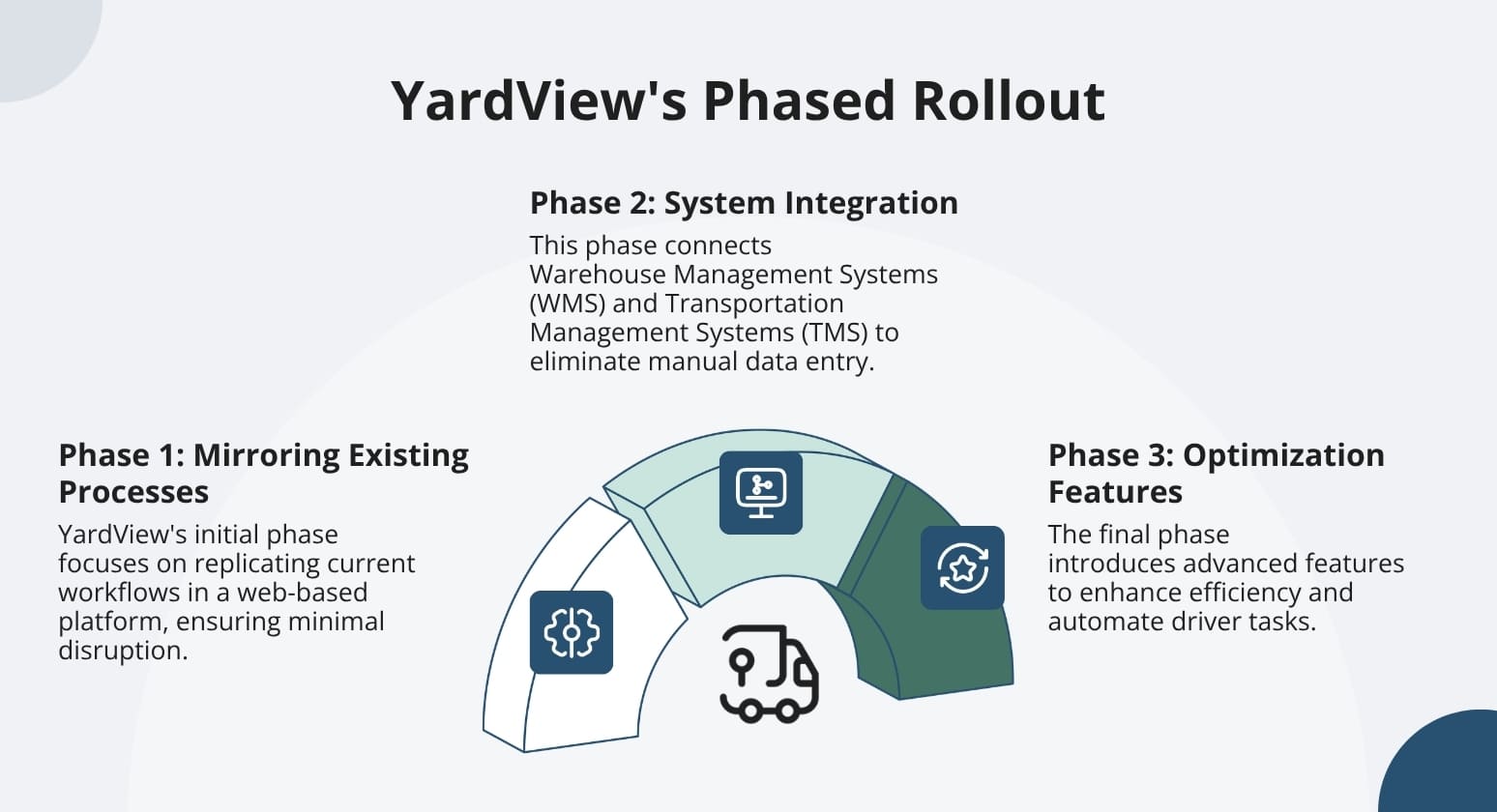
YardView's three-phase methodology de-risks rollout by starting conservatively.
- Phase 1 mirrors your existing processes in the web-based platform — your team keeps working while the system comes online.
- Phase 2 connects your WMS and TMS, eliminating manual data entry.
- Phase 3 adds optimization features that cut move times and automate driver tasking.
Each phase delivers value before the next begins.
YardView typically deploys in 6 weeks or less, which contrasts sharply with enterprise YMS rollouts that could stretch for months.
- Week one maps your current trailer lifecycle and operational constraints.
- Weeks two through four configure the system around your existing processes while your team gets trained.
- Week five handles integration with your WMS or TMS via API connections. You're live by week six, with full visibility replacing spreadsheets and radio calls.
Training Frontline Staff in Under an Hour
YardView's remote training gets frontline staff productive in under an hour. Color-coded interfaces and 1–2 click task completion eliminate the learning curve that kills adoption at busy facilities.
High turnover and varied tech skills make this critical. Your new gate guard starts helping right away. Your yard driver also starts helping right away. They don't need weeks of training first.
Stop Managing Carrier Appointments. Stay Ahead of Every Arrival.
YardView replaces daily yard chaos with automated workflows that keep freight moving and yards productive.
- Carriers and vendors self-schedule through secure portals based on real-time dock availability, eliminating the constant stream of inbound calls and email chains that bog down your operations staff
- QR code-based check-in via drivers' own devices triggers automatic gate processing and directed parking instructions the moment a carrier arrives — no app downloads, no manual data entry
- The dock scheduling module tracks wait time, dwell, and door activity after arrival, with detention threshold alerts that fire before fees accumulate
- Appointment confirmations automatically generate gate passes, and SMS-based driver direction keeps arrivals moving through your facility without constant staff intervention
- Color-coded calendar views show your team which docks are overbooked before the morning rush hits
See how YardView manages the complete carrier appointment lifecycle, from initial scheduling through final departure.
FAQs:
What Is Appointment Management for Carriers?
Appointment management for carriers is a process. It schedules when carriers arrive at your facility. It confirms which dock they use. It tracks what happens after they check in.
You get accurate visibility into scheduled arrival times. You see real-time dock use instead of radio talks.
How Does Digital Appointment Management Benefit Carriers and Shippers?
Carriers eliminate gate queuing time and get directed parking instead of hunting for open spots. You know exactly which dock to use and when you're cleared to depart. Shippers cut detention exposure by preventing uncoordinated arrivals that stack drivers at the gate.
Your docks stay productive because carriers arrive when you're ready, not when it's convenient for dispatch.
What Features Should Carriers Look for in Appointment Management Software?
SMS-based driver communication removes the need for app downloads for one-time visits.
Post-arrival tracking captures actual dwell time, not just appointment slots. Integration connects to your TMS via API or EDI. Look for systems that handle both scheduled and walk-up arrivals.
How Does Appointment Management Reduce Dwell Times and Detention Fees?
Pre-scheduled appointments eliminate unplanned gate queuing that keeps trailers idle before they even reach a dock. Directed parking cuts the time your spotters spend searching for open bays.
Real-time dwell tracking shows exactly how long each trailer has been sitting. Proactive alerts fire when dwell approaches detention thresholds, so you can move trailers before fees start accumulating instead of discovering the charge on next week's invoice.
How Do Carriers Schedule Appointments with Shippers?
Carriers schedule appointments through four primary methods. They can book directly via secure self-service portals that show real-time dock availability. Systems automatically create appointments when connecting to TMS platforms.
The system also triggers appointments automatically. This happens based on predefined rules or incoming shipment data.

%20(1).png)