

Key takeaways:
- CTPAT compliance at the yard comes down to proving that a specific seal was checked and a specific container was inspected on a specific date by a named person before the load moved.
- CBP's minimum security criteria apply to the yard in four areas: physical access controls at the gate, container and trailer inspection, seal integrity, and an auditable chain of custody for every move.
- Blind seal verification hides the seal number and requires a physical match before release, so gate staff read the actual seal rather than copying a number off paperwork that could hide a swap.
- A yard management system that stores every transaction with a full audit trail answers a validator directly, while snapshot-only systems leave you digging because they cannot show what a seal read months back.
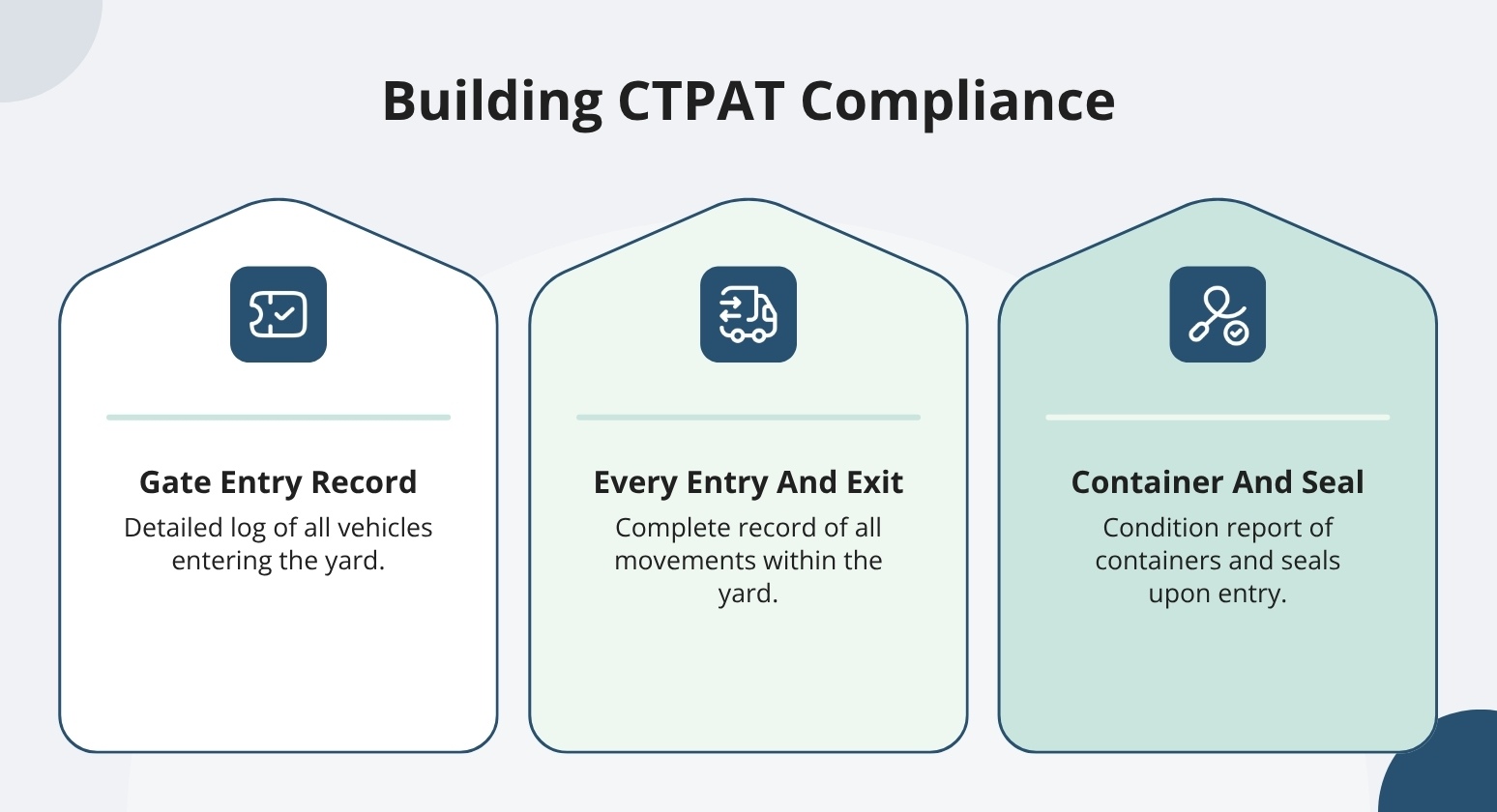
CTPAT asks a facility to prove three things about the yard. Who came through the gate, what condition the container and its seal were in, and a complete record of every entry and exit. However, for most yards, paper logs and radio calls make it slow to assemble those proofs when an audit lands.
This article walks through the full spectrum of CTPAT compliance, shows where most yards fail, and explains how a yard management system turns the requirement into a record you can pull.
What is CTPAT?
CTPAT (Customs Trade Partnership Against Terrorism) is a voluntary CBP program that asks facilities to secure their supply chains against smuggling and tampering.
At the yard, that means four things you can point to:
- Identified drivers and screened arrivals at the gate
- Documented container and trailer inspections
- Seal numbers verified against paperwork
- A retrievable record of every move in between
The program asks you to prove a specific control happened on a specific unit on a specific day, regardless of your process quality.
Membership sits with importers, carriers, brokers, and logistics providers. If your site handles inbound or outbound containers for a CTPAT member, that member's security requirements reach your gate through its business-partner obligations, whether your company name is on the certificate or not.
Distribution centers, manufacturing plants, and 3PL yards all fall in scope the moment they touch containerized freight moving through a member's chain.
Where CTPAT Compliance Fails in Real Yard Operations
CBP wants you to control and monitor who enters the property and what they bring. That means identifying drivers and visitors, screening against expected arrivals, and maintaining a record that ties each entry to a person and a purpose.
The gate owns this. Every truck at the shack is a decision: Is this driver expected? Does the appointment match? Should this tractor-trailer be here today?
Access control fails when the gate runs on a clipboard and a radio. A guard waves in a driver whose name may or may not be on the sheet, and the record sits in a binder that can go missing between shifts.
When Inspection Records Live on Paper and Can't Survive an Audit
Imagine a guard glances at a bolt seal, sees a number that looks right, and waves the trailer through. No comparison against the manifest, or a record that the check occurred. If that seal was swapped, or the number never matched the paperwork, nothing shows that anyone verified it.
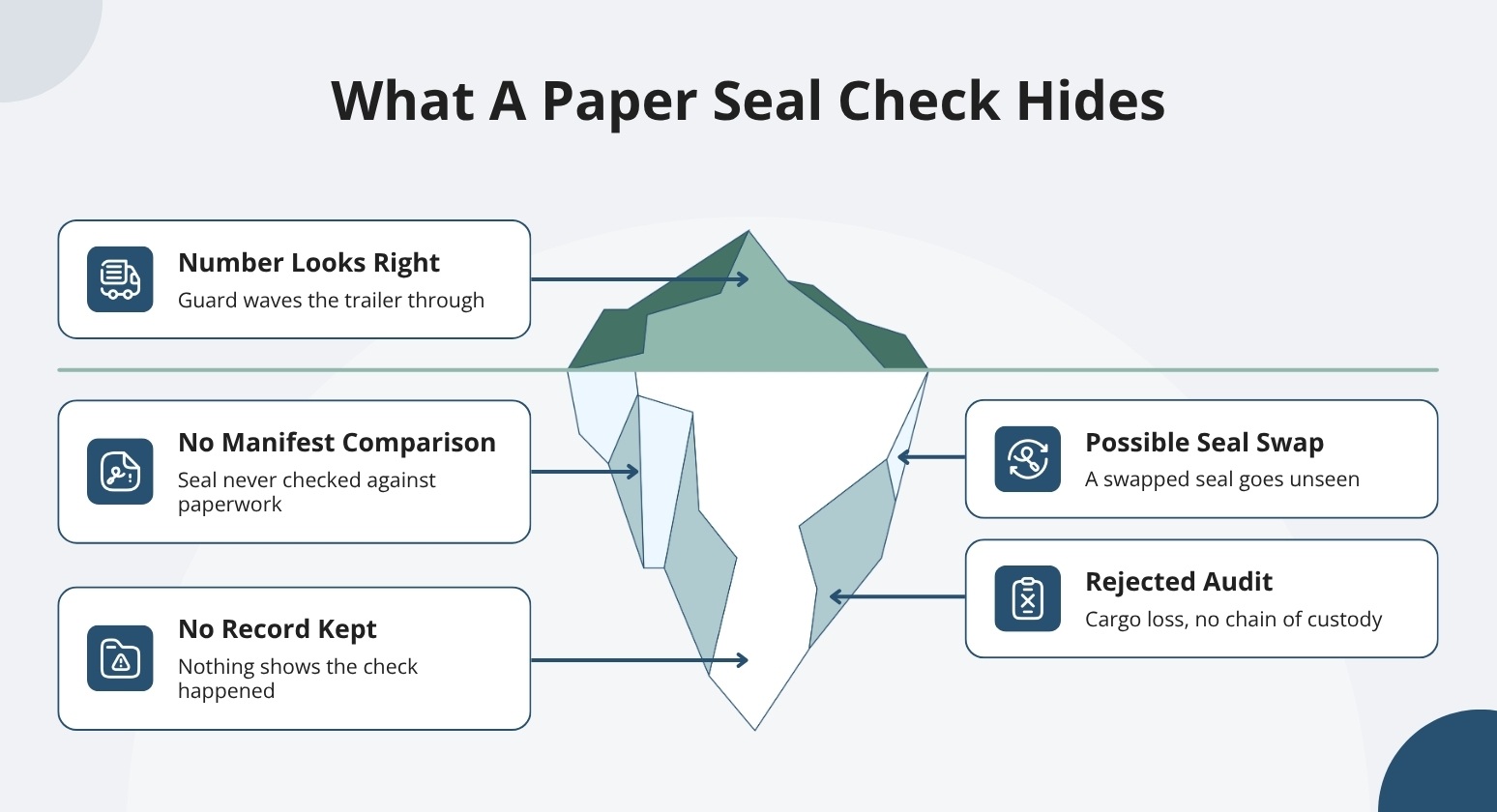
The exposure runs from a rejected audit to a real cargo loss with no defensible chain of custody behind it.
When Seal Checks Rely on Memory Instead of a Documented Match
If a loaded trailer turns up in the wrong spot or goes missing, reconstructing what happened means stitching together radio calls, a spotter's recollection, and gate logs in a separate system.
No one holds the full picture, so the reconstruction turns into finger-pointing across shifts. This is the access-control and chain-of-custody exposure CTPAT targets: proving who entered, what they moved, and when.
One timestamped record tied to driver identity and every in-cab move replaces three partial ones. The same history that settles the internal dispute also answers the auditor.
When No Single Record Answers "Who Moved This Trailer and When"
The way out of lost paperwork is to make the record a byproduct of the work that the gate staff and drivers already do. Access control and inspection only hold up if you can trace an asset from gate to dock to departure.
CTPAT and CBP require a chain of custody: a continuous record of who handled the container, where it was stored, and when it was moved. The evidence is a timestamped event history for the full visit. When a validator asks about one load, the history answers without a paper hunt.
How to Evidence CTPAT at Your Yard Without Paper Logs
The right approach to CTPAT compliance is to capture the evidence as a byproduct of the work your gate staff and drivers already do, so each check writes itself into a record you can pull later. These six steps move a yard from paper logs and radio calls to a timestamped trail that answers a validator's first ask.
Start with the system that would hold that record, then close the gaps around it.
1. Evaluate a Yard Management System
If you are weighing a yard management system to address most of these weak points, judge its capabilities that produce CTPAT evidence, not its feature count.
Four criteria matter most:
Score your current setup against each row. Validators press hardest on the rows where you score lowest.
2. Assess Where Your Current Gate, Seal, and Recordkeeping Fall Short
Before you fix anything, you have to see where records slip through today. Walk your own gate, seal, and inspection process against what CTPAT expects. The weak spots surface fast, and that map becomes your evaluation checklist.
For instance, a seal check tracked only in memory leaves nothing you can hand to an auditor months later. Inspection steps get skipped when the yard is slammed, and no timestamp proves whether they happened.
When the record exists only on paper or in someone's head, rebuilding it during validation puts the entire review at risk.
3. Standardize Gate Check-in and Carrier Verification
Access control only holds up when every driver who reaches your gate gets checked the same way. When each lane runs its own routine, verification records vary shift to shift, and auditors catch that inconsistency first.
Set one check-in method, and the gate produces a clean, timestamped record without anyone having to remember. Choose a single primary method that the whole site follows. Before you release a driver into the yard, confirm the check-in transaction has been recorded.
4. Enforce Seal Verification at Check-in and Check-out
Once a driver clears the gate, the seal is the next control point and the one most likely to slip when checks live on paper and radio. Build verification into the check-in and check-out workflow so it runs on every arrival and release.
Each verification writes a timestamped entry into the yard's transaction history, so it records what happened, when it happened, and who did it in a single record. When a CTPAT or customer audit asks you to evidence seal integrity, you pull the record instead of rebuilding it.
5. Keep a Timestamped Audit Trail of Every Gate and Yard Event
When CBP validators walk through your facility, they trace a container from the moment it hits the gate through every hand that touches it. Timestamped logs, full audit trails, and chain-of-custody records for every gate, yard, and dock event give you that trace, built in.
With modern YMS, you get a single-tenant setup, meaning each customer has a dedicated database, simplifying compliance for regulated operations. The same audit-trail approach carries over to WAIRE and FSMA reporting, where those apply.
6. Run Internal Audits and Corrective Reviews on the Stored Trail
Run a quarterly self-assessment against the criteria, plus a lighter monthly pull on the two areas most prone to slip: seal verification and inspection completion. That cadence keeps the trail current between validations and turns the review into a routine data read rather than a rebuild.
When a self-assessment flags something, the same trail traces it. A missed inspection or a seal mismatch pattern on one shift is recorded in the timestamped log, with the driver, the asset, and the time attached.
You find the root cause, document the corrective action, and keep the evidence of the fix in the record.
How YardView YMS Brings CTPAT-Grade Security to Every Gate, Yard, and Dock Event
Meeting CTPAT expectations at the yard means proving that every trailer, seal, and gate transaction is accounted for with an unbroken chain of custody. When arrivals live on clipboards and whiteboards, that proof is hard to reconstruct, and mis-releases become a real risk.
Here’s how YardView YMS provides you with timestamped digital records and verification controls built directly into gate, yard, and dock workflows:
- Blind Seal Verification: Hides the seal number and requires a physical match before releasing a trailer, guarding against mis-releases and theft at the point of departure.
- Chain-of-Custody Records: Captures timestamped logs and full audit trails for every gate, yard, and dock event, giving verifiable documentation for security reviews.
- Gate Management Controls: Handles touchless, manned, or unmanned gates with QR check-in, AI-powered OCR cameras, GPS geofencing, and a Fast Pass lane for trusted carriers.
- Real-Time Yard Visibility: Presents a graphical drag-and-drop map with up to 20 data points per asset, so every trailer's status, location, and dwell is accounted for at a glance.
- Yard Audits and Lot Check: Lets drivers verify asset locations, flag missing assets to a virtual "lost" location, and update conditions directly from the in-cab device for rapid inventory checks.
See how YardView's gate, seal, and audit-trail controls turn CTPAT readiness into a byproduct of daily yard work, so the record is already built when a validator arrives.