
Key takeaways:
- Pushing your best yard's workflow to every site stalls rollouts, because facilities with different layouts, crews, and gates cannot run one rigid process and local teams quietly revert.
- The version that holds enforces one network standard for reporting and rollups while each site keeps its own gate, move, and configuration choices under local control.
- YardView implementations take six weeks or less per site, with no proprietary hardware and about an hour of end-user training, so a network can scale without downtime it cannot absorb.
- Single-tenant architecture gives each customer a dedicated database and application instance, keeping every 3PL client's yard data isolated even as the account roster grows.
If you run your yard management system (YMS) at one site, you probably have no problem. Take it across a dozen facilities and a handful of 3PL clients, and it becomes a different job, because the instinct that got you here works against you now. The instinct is to find the workflow that runs clean at your best yard and push it to every location as the standard.
This guide walks through four steps to set that standard, get consolidated visibility, and onboard new sites and clients without the downtime a running network cannot absorb.
1. Audit Gating and Reporting Workflows at Each Site
You need three things in hand at every location:
- Name a site contact and a 3PL contact who own the yard process day to day
- Get read access to how each facility runs its gate, moves, and reporting
- Confirm a data source for the existing WMS, TMS, or ERP feeds, because those connections drive the integration phase later
Walk each site and record the gate as it stands: manned booth, unmanned lane, kiosk, or QR check-in on the driver's device. Note how spots and shuttles get tasked and who tracks status.
Then capture how the facility reports today, whether that is a shared dashboard or a spreadsheet emailed.
Lay the findings side by side so the spread is visible before you commit.
The pattern in that table shows which practices are worth keeping local and which must be standardized.
2. Define One Network Standard for Reporting and Rollups
Every site reports its numbers differently, so a network layer above whatever each site does day to day matters.
Start by defining the handful of metrics leadership will govern by, then require every site to report into the same fields. Dwell, detention exposure, and load status per facility have to mean the same thing at every location, or the rollup is fiction.
A network-ready YMS consolidates empties, loaded counts, and load types per facility, plus network views by carrier. With more than 110,000 yard moves managed monthly across the customer base, the rollups hold at network scale rather than choking above a few sites.
The daily mechanics stay under local control. A cross-dock with heavy carrier traffic runs manned gates; a smaller site runs an unmanned kiosk or QR check-in on the driver's own device.
Move sequencing gets configured to the layout and crew already in place. Standardizing the reporting layer does not require one physical process at sites that were never built the same way, and that is the whole point of splitting the two.
With comparable numbers defined, the platform question becomes narrower.
3. Use a YMS That Functions Without Extensive Hardware
Once the standard is settled, the platform decision comes down to one plain question: how much disruption can each facility absorb during rollout?
Rollout speed helps little if every site needs sensors installed first. The savings come mainly from software, so no proprietary hardware is required, and you reuse the GPS already in your yard trucks.
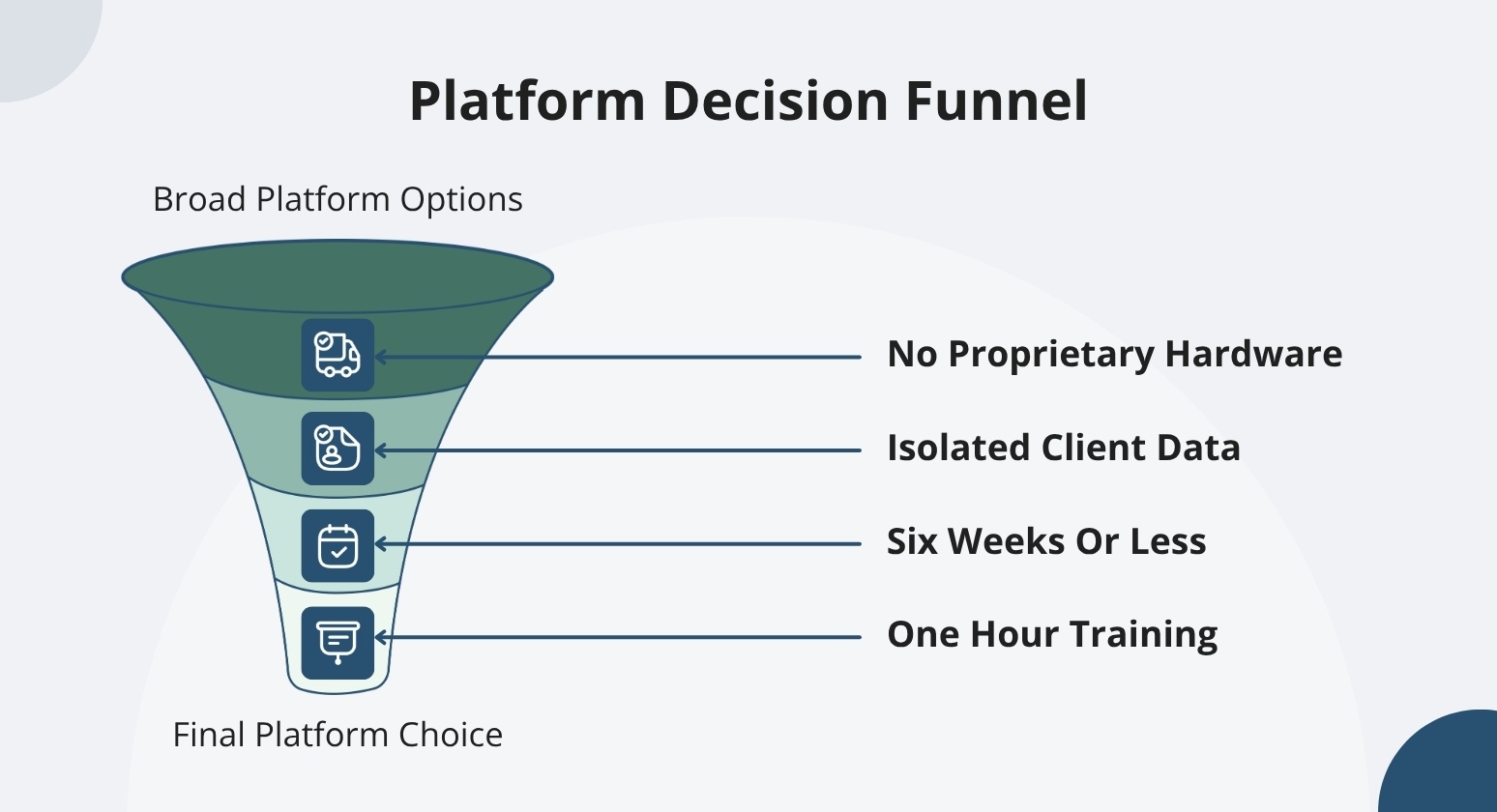
Each criterion cuts the shortlist further, from hardware needs down to how fast crews learn it
For 3PL operators, data scoping is the second half of this criterion. YardView's single-tenant architecture gives each customer a dedicated database and application instance, so one client's yard data stays isolated from the next as you add accounts.
Deployment speed matters as much as the tooling. A platform that goes live in six weeks or less per site, with about an hour of end-user training, lets a network scale one facility at a time without pulling crews off the yard. That pace is what keeps a multi-site rollout from stalling between go-lives.
Ease of use carries the same weight across a network. Gate guards, spotters, and clerks turn over, and site teams vary in how tech-comfortable they are, so a system a new user can learn in about an hour holds up better across a dozen facilities than one that needs a specialist at each.
4. Pilot at One Site, Then Sequence the Network Rollout
Prove the standard at one facility before you commit the network. Pick a pilot site that resembles the rest of your operation, run it through the same phased approach every future site will follow, and you get a repeatable pattern.

Phase 1 mirrors the pilot site's existing trailer lifecycle and gate process into the platform as they run today, so nobody relearns their job on day one. Once the site is live, check that its data rolls up into your network reporting standard as scoped.
If dwell, load status, and move metrics land in the consolidated view in the format leadership expects, the standard holds, and the pilot is worth repeating.
With the pilot validated, move each site through the same phases. Phase 2 connects the local WMS, TMS, or ERP and layers in custom reporting and business logic. Phase 3 assesses cost-effective add-ons like barcode, RFID, or GPS, using in-cab devices where they already exist.
Sequential go-lives carry the lessons from one site into the next. By the third or fourth site, launches follow a rhythm your team already knows.
Unify Every Yard in Your Network Under One Live View
Scaling yard operations across multiple sites and 3PL partners usually means juggling mismatched processes and disconnected systems. YardView replaces the clipboards, whiteboards, and site-by-site spreadsheets with one web-based platform that brings gate, yard, and dock operations into a shared, real-time view:
- Enterprise and Network Analytics: Roll up inventory, driver metrics, scheduling, and detention data into enterprise and network-wide views with dashboards and scheduled email delivery.
- Single-Tenant SaaS on AWS: Each site network runs on a dedicated database in a SOC 2 environment with a 99.9%+ uptime SLA and 24/7 U.S.-based support.
- Broad Integration Layer: Connect any WMS, TMS, or ERP through REST/SOAP APIs, flat files, SFTP/FTPS, EDI, and a CSV upload wizard, with named partners including SAP, Manhattan Associates, Trimble, and Softeon.
- Carrier and Customer Portals: Give 3PL partners, carriers, and customers self-scheduling and read-only access so every site coordinates without extra manual handoffs.
- Phased 3-Phase Rollout: Mirror current processes first, then integrate systems with custom reporting, then layer in add-ons like barcode, RFID, and GPS, with implementations typically completed in six weeks or less.
See how YardView rolls up every yard in your network into one live view, so leadership reads one standard while each site keeps its own gate and moves.
Frequently Asked Questions:
Do We Need to Install Sensors or New Hardware at Every Yard?
No. The savings come mainly from software, and YardView requires no proprietary hardware at any site. You use the GPS already in your yard trucks, run gates through QR check-in on the driver's own device, and let staff work from PCs, tablets, or in-cab devices you already own. Keep barcode, RFID, and GPS as optional inputs you evaluate in the third rollout phase, only where they earn their cost. A hardware mandate at every yard would slow the rollout and inflate the budget before you see any return.
Can One YMS Handle Sites and 3PLs That All Run Different Workflows?
Yes. The platform holds one standard for the network while each site handles its own daily activities. Reporting, benchmarking, and rollups stay consistent across every location, so leadership compares facilities on the same metrics. Local gate configuration stays flexible: one site runs a manned gate, another runs unmanned QR check-in, a third runs a kiosk. The network standard governs what you measure and how it rolls up. Site-level choices govern how each yard runs, given its layout and team.
How Do We Keep Each 3PL Client's Data Separate as the Network Grows?
Single-tenant architecture gives each customer a dedicated database and application instance, so data stays isolated by design. For a 3PL running a multi-client network, that isolation keeps per-client and per-site records scoped correctly no matter how many accounts you add. You still get consolidated network views across every facility and client for your own leadership reporting, while each client sees only what belongs to it through read-only portals. This also simplifies compliance for clients in regulated industries.
Is a YMS Bundled with Our WMS Good Enough for a Multi-site Network?
A WMS extension often lacks what a network needs. Bundled yard functions often lack the real-time visibility, task automation, and configuration flexibility that complex, multi-site yard environments demand, which shows up as longer dwell times, manual workarounds, and higher detention costs. A WMS manages inventory flow inside the building. Across a network, it leaves yard blind spots and inconsistent standards between sites. A dedicated YMS gives you the cross-site rollups and per-site configuration a bundled tool cannot, which is where the network standard comes from.