Key Takeaways:
- Detention, demurrage, and per diem apply to different assets, run on different clocks, and apply at different locations, so the terminal fence line determines which fee applies and who owes it.
- Detention runs $30 to $50 per hour at your facility, while demurrage can reach $300 per day inside the terminal, making a few unaccounted-for hours costly.
- Facilities that accept carrier invoices at face value often lose disputes because manual gate logs struggle to record exactly when equipment arrived, was docked, and departed.
- Tracking demurrage by steamship line and detention by carrier as separate categories surfaces recurring cost drivers and cuts fees.
Detention, demurrage, and per diem get lumped together in conversations, yet each fee tracks a different asset on a different clock. That confusion can cost money. Companies routinely pay detention at $30 to $50 an hour and demurrage as high as $300 a day, and much of it traces back to dwell time that is counted by hand or later reconstructed from a carrier invoice.
This article sorts the three fees by asset, location, and who bills them, then shows how a yard management system timestamps each event so you can calculate, defend, and prevent every charge.
What is the Difference Between Detention and Demurrage?
Detention covers a trailer or driver held past free time at your facility and is billed hourly. Demurrage applies to a container sitting beyond free days at a port or depot, billed per day and tracked by the steamship line. Per diem covers equipment held past its agreed free time.
Here is how the three stack up across the dimensions that matter:
Detention lives on your side of the gate. When a trailer or driver waits at your dock beyond the free time specified in the carrier contract, the clock starts, and you're charged. Rates run $30 to $50 an hour, and every minute of that is something you can see happening in your own yard.
A Deep Dive Into Demurrage Fees for Facility and Logistics Teams Working With Ports
Demurrage is a per-day fee that applies when a container remains at the port or terminal past its free time. The clock runs against the shipping line's equipment sitting on port property, not against a driver waiting at your dock.
Three things decide what you owe:
- When the charge starts
- How many free days did you have
- Which steamship line set the terms
Get any of these wrong, and you either pay a fee you could have avoided or dispute an invoice you cannot document. Here is how each factor plays out.
When Demurrage Charges Apply (Discharge to Gate-Out)
Demurrage begins the moment the vessel discharges your container at the terminal and ends when the box is picked up and gated out. Most ports hand you 3 to 5 free days inside that window.
The exact number depends on the terminal and what your contract negotiated, so don't assume the allowance is the same across two ports you use.
Plenty of things push a container past its free time:
- Chassis shortage: When no chassis are available at the terminal, the container can't leave, even with a truck sitting there ready to pull it.
- Appointment scarcity: A full pickup calendar leaves a container sitting through its last free day until a slot finally opens.
- Customs or documentation holds: A container flagged for inspection remains at the terminal until the hold clears.
- Consignee capacity: When your receiving warehouse has no room to take the load, the box waits at the port on your dime.
Once free time expires, the per-day rate accrues until gate-out. You'll see demurrage up to $300/day cited across industry materials, and that's why the day a container crosses its threshold matters far more than any monthly average.
How Free Days and Escalation Tiers Work at the Port
Free days are your buffer, and escalation tiers kick in once the buffer runs out. Most ports don't charge one flat daily rate. The fee climbs the longer a container sits, so days 6 and 7 can cost more per day than your first day past free time.
A few terms decide the final number on the invoice:
- Free days: the number of days a container can sit before any charges start, as set in your contract with the steamship line.
- Escalation tiers: rate bands that raise the per-day cost as dwell time extends, often stepping up after the first few chargeable days.
- Holidays and weekends: some terminals exclude non-working days from the free-time count; others don't, and that changes when the clock trips.
Counting these by hand is where mischarges creep in. When your team estimates free days from memory or a spreadsheet, one miscounted holiday can push a container from zero fees straight into a top escalation tier. Tracking each day against the specific terms is how you avoid paying for a threshold you never crossed.
Exploring Detention for Yard Operations Managers Running the Gate and the Dock
Detention is the hourly fee a carrier charges when their trailer or driver sits at your facility past the free time you agreed to. It lands on the facility side of the fence, and if you run the gate and dock, you carry the weight of it.
Three questions decide whether a charge is fair:
- When the clock started
- How long has free time run
- Where the proof lives
Answer all three with hard timestamps, and the charge is defensible. Answer them from memory, and you usually pay. Here is how the clock actually runs.
When Detention Charges Apply
Detention runs on time you own inside your own fence. The clock covers the window between gate arrival and empty return, or between arrival and the trailer's departure from the dock. A carrier drops a load, the trailer sits waiting for a door, your dock crews fall behind, and the free hours burn off.
What triggers the charge is straightforward:
- Gate-out to empty return: The clock runs from the moment a driver checks in until the trailer clears the yard or returns empty.
- Dock wait beyond free time: A trailer parked at or near a door past the agreed window starts accruing hourly fees.
- Live load or unload delays: When a driver waits with the equipment during loading, the detention meter often keeps running against your facility.
Rising detention and demurrage costs are one of the most common reasons a yard operations manager starts shopping for a system.
How Free-Time Windows and Holiday Adjustments Vary by Carrier
Free time depends on each carrier's contract. One carrier can give you two hours on the dock before detention starts. The next can give you four. A third can stretch or shrink the window around weekends and holidays.
That way, the same trailer, sitting for the same length of time, gets charged differently depending on whose name is on the agreement.
How YardView Turns Detention and Demurrage Into a Tracked, Disputable Line Item
Most facilities lose money on detention and demurrage because dwell time is counted by hand, reconstructed after the fact, or taken straight from a carrier invoice that arrives weeks later, with charges no one can trace.
YardView runs detention and demurrage as a dedicated capability, pairing real-time dwell-time tracking with proactive alerts that fire before fees accumulate.
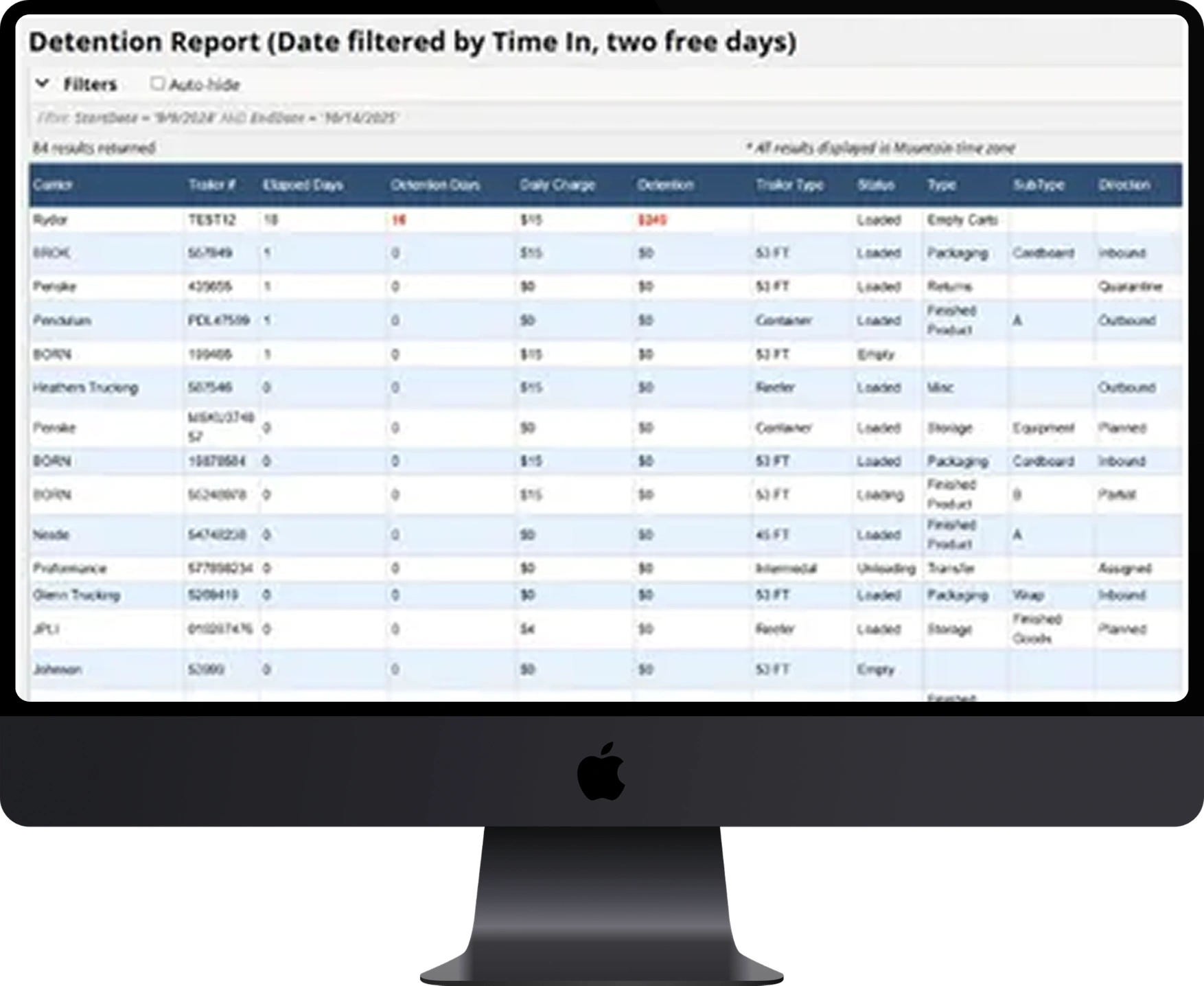
Here’s how YardView timestamps every gate, yard, and dock event and surfaces dwell:
- Real-Time Dwell Tracking: Monitors how long each asset remains across docks, yard spots, and waiting zones, so mounting charges are visible before they escalate.
- Proactive Threshold Alerts: Fire detention and demurrage notifications before fees begin accruing, giving time to act rather than react.
- Audit Trails for Disputes: Captures timestamped chain-of-custody records for every gate and dock event to support charge disputes with hard evidence.
- Billing Reconciliation: Ties tracked dwell and event data directly to charge validation, so invoices match what happened in the yard.
- Detention and Demurrage Analytics: Delivers dedicated reporting and dashboards with scheduled email delivery, turning raw dwell data into clear operational insight.
See how YardView's detention and demurrage tracking timestamps every arrival, dock, and departure, so your team can catch fees before they climb and challenge the ones that don't add up.
FAQs
Is Per Diem the Same as Detention?
No. Per diem is the daily charge a steamship line applies when you hold its container or chassis past free time, usually after it leaves the terminal. Detention is what you owe when the driver and trailer sit waiting at your dock. Track per diem days and dollars against the container and chassis; track detention start and finish against the driver and trailer; and ensure every charge stays tied to the asset that generated it.
Can Detention and Demurrage Fees Be Disputed?
Yes, and documented evidence wins. When a carrier issues a detention charge, you need to prove exactly when the trailer arrived, when it hit the dock, and when it left the dock. Without those timestamps, you're arguing from memory against a carrier who has a system on their side. YardView generates audit trails for dispute resolution and supports configurable rules for fee structures, free days, and escalation settings. That means you can pull a charge, match it against your own gate and dock records, and see where the numbers diverge.
What Is Free Time in Shipping, and How Does It Affect These Fees?
Free time is the grace window before fees start accruing. Every trailer at your dock and every container at the terminal comes with a set number of hours or days it can sit at no charge. The instant that the window closes, detention, demurrage, or per diem starts running.