
Key takeaways:
- For a dedicated yard system that deploys fast on the stack you already run, YardView is the strongest fit and the best-rated option here (4.9/5 on Capterra).
- For deep, made-to-fit configuration across dock and yard, C3 Solutions is the specialist pick (4.7/5 on G2).
- For one vendor across ports, rail, ocean, and the yard, Kaleris has the broadest reach and a top-ranked YMS.
- For a camera-run, autonomy-seeking yard, Terminal Industries is the AI-native option, though it is the youngest here.
- For yards that must live inside SAP or Oracle, SAP Yard Logistics and Oracle Warehouse Management keep the yard native to that cloud.
Blue Yonder runs the yard as one module inside a large warehouse and supply chain suite, which fits some enterprises and overwhelms others. Most teams start shopping for an alternative when implementation runs long, costs climb past what a yard project can justify, or the module cannot flex to how a specific yard actually works.
The right replacement depends on the job you are hiring it for. A dedicated yard system, a broad multi-modal suite, and an SAP or Oracle-native module each win a different kind of operation.
This guide compares six alternatives by the yard they fit best, so you can match one to yours.
An Overview of the Best Blue Yonder YMS Alternatives
Enterprise yard software rarely lists public pricing, so evaluate the factors that separate a fit from a mismatch:
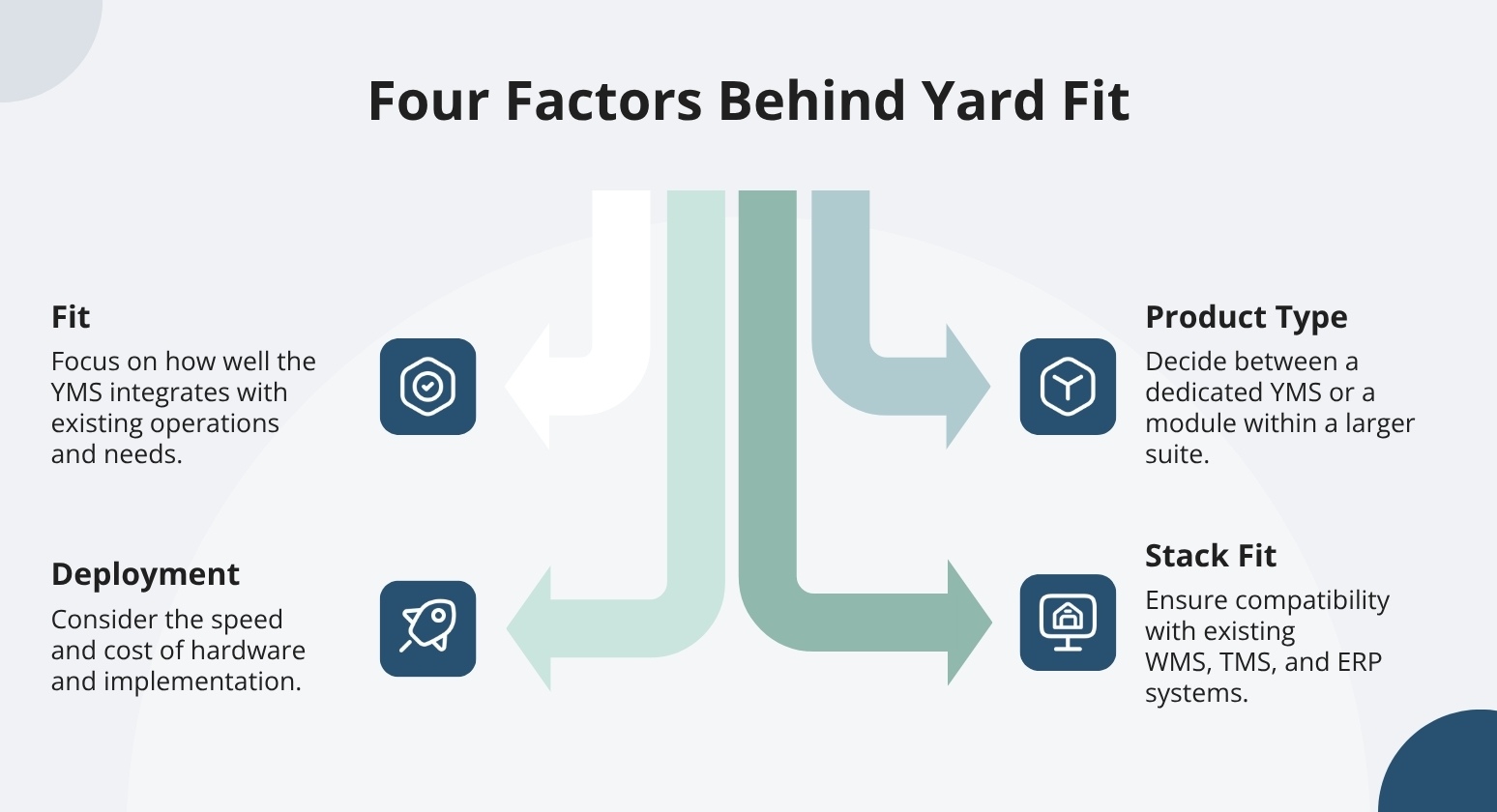
Public pricing is rare, so fit factors do the separating instead.
- Whether it is a dedicated yard system or a module inside a larger suite
- How fast it deploys and how much hardware it demands
- How well it works with the WMS, TMS, or ERP you already run
- Whether third-party reviewers back up the vendor's own claims
No tool wins on all four, which is the point of comparing by fit rather than by feature count:
The first three are dedicated yard products you can run without adopting a wider suite. Kaleris is a broad suite that happens to carry a top-ranked yard module, and the last two keep the yard native to an SAP or Oracle stack you already own.
1. YardView
YardView is a dedicated, web-based yard management system that runs gate, yard, and dock operations on their own, without asking you to adopt a larger warehouse suite to get there. Founded in 1998, YardView brings decades of yard management expertise.
Because the yard is the whole product, not a module, the setup reflects real yard complexity: a drag-and-drop console showing up to 20 data points per asset, directed parking and move rules, in-cab next-best-move tasking, and detention and demurrage tracking.
Watch: YardView's Drag-N-Drop yard map #YMS #supplychain. Clip demonstrates the drag-and-drop yard map with per-trailer data on hover.
It runs on the PCs, tablets, and in-cab devices you already own, and drivers check in with a QR code on their own phone, so you don't need to buy proprietary hardware.
That focus is what separates it from a suite module. While Blue Yonder's yard sits behind a large warehouse platform, YardView is built specifically for the yard, which means faster rollout and lighter change management. Most implementations run about six weeks, and end-user training takes roughly an hour.
YardView pros:
- Dedicated, not a module: The full platform is built for gate, yard, and dock, so yard-specific workflows go deeper than a suite add-on.
- No proprietary hardware: Runs on existing devices and QR check-in, and can reuse the GPS already in your yard trucks.
- Fast to stand up: About a six-week deployment and roughly an hour of training, with integration to any WMS, TMS, or ERP.
YardView cons:
- Not a warehouse suite: If you want yard, warehouse, and transport under one vendor, YardView focuses on the yard and integrates with the rest.
- Public pricing is not listed: Like most yard software, pricing is quote-based.
Pricing: Quote-based. YardView positions itself as accessible at a local-budget level with flexible, start-and-stop contract terms rather than an enterprise-only commitment.
Best for: Operations that want a dedicated yard system live quickly on the systems they already run, with the highest third-party rating in this set.
2. C3 Solutions
C3 Solutions is a dedicated dock-and-yard specialist that has built yard software since 2000, organized into three products: C3 Reservations for dock scheduling, C3 Yard for yard management, and C3 Hive for carrier and supplier collaboration.
Its through-line is configuration. C3 leans hard into tailoring appointment rules, yard logic, gate steps, and reports to how a given facility already runs, rather than asking the operation to change. For a complex, high-volume site with settled processes, that depth is the draw.
That same depth is the trade-off. Reviewers note a steeper learning curve, and a made-to-fit system means more upfront configuration to set and align the rules. C3 is a specialist you shape to your operation, not a system you switch on in a week.
C3 Solutions pros:
- Deep configurability: Appointment durations, yard rules, and gate steps are all user-defined.
- Proven dock-and-yard focus: More than two decades building for large, high-volume yards.
- Strong reviews: 4.7/5 on G2 for C3 Yard.
C3 Solutions cons:
- Steeper learning curve: The configuration depth adds setup and training time.
- No document-to-billing layer: It centers on dock, yard, and collaboration.
Pricing: Quote-based, not publicly listed. Expect an enterprise configuration engagement rather than a quick self-serve setup.
Best for: Established, process-heavy facilities that want a made-to-fit dock-and-yard system and have time to configure it.
3. Terminal Industries
Terminal Industries is an AI-native Yard Operating System built around computer vision. Founded in 2023, its product reads trucks in at the gate with cameras, identifies and locates assets, and pushes toward a yard that runs with minimal manual input.
It leans on its own camera kit rather than RFID, reports gate-processing time cut by a large margin in its own materials, and layers on agentic workflows meant to re-task spotters as conditions change. For a team that believes the yard should move toward running itself, it is the most aggressive bet here.
The trade-off is maturity and scope. Terminal is the youngest vendor in this set, its deployment base is smaller, and its Gartner Peer Insights rating, while a perfect 5.0/5, rests on only a handful of early reviews. It is also vision-first, so its strength is the automated gate and yard rather than a broad document or billing layer.
Terminal Industries pros:
- AI-native gate and yard: Computer vision handles identification and check-in with little manual input.
- Fast core deployment: A core phase can go live in about five days.
- No RFID tags: Tracking runs on cameras rather than tags on every asset.
Terminal Industries cons:
- Young and less proven: Founded in 2023, with a small review base.
- Camera-dependent and vision-first: Value concentrates in the gate and yard, not documents or billing.
Pricing: Quote-based, not publicly listed.
Best for: Yards chasing maximum automation that are comfortable adopting a newer, camera-driven platform.
4. Kaleris
Kaleris is a broad, multi-modal supply chain execution suite that spans terminal operating systems, ocean and rail, transportation, and yard management, with a YMS that ABI Research ranked first in its category in 2023.
For the yard specifically, Kaleris offers gate automation, dock and appointment management, and RTLS-based asset tracking, sold in tiers from a lighter setup to a full sensor-based deployment for large, high-volume yards. Its pitch is one vendor from the terminal at the port to the trailer in the yard.
The trade-off is scope. If your problem lives inside a single facility, you may not use much of Kaleris's multi-modal breadth, and the full RTLS tier brings hardware and cost that a software-first yard avoids. It fits enterprises operating across ports, rail, and yards more than a single distribution center.
Kaleris pros:
- Broadest reach: One vendor across terminals, ocean, rail, transportation, and yard.
- Top-ranked YMS: ABI Research named its YMS the category leader in 2023.
- Precise RTLS tracking: Sensor-based location for asset-dense, high-volume yards.
Kaleris cons:
- More than a single yard needs: The multi-modal suite is broad for a single facility.
- Hardware for full tracking: The top RTLS tier depends on sensors.
Pricing: Quote-based, not publicly listed; expect an enterprise engagement.
Best for: Enterprises that want ports, rail, ocean, and the yard managed under one vendor.
5. SAP Yard Logistics
SAP Yard Logistics is a yard module for companies running SAP, sitting between SAP Transportation Management and SAP Extended Warehouse Management. It models yard work as yard requests, orders, and tasks, with dock appointment scheduling, a 3D yard cockpit, and native yard settlement.
Its strength shows when it runs alongside SAP TM and EWM on S/4HANA, where the yard shares one data model with transport and warehouse under a single vendor. A freight order, an unload, and a yard move all reference the same objects, with no middle layer to integrate.
The trade-off is the commitment. SAP Yard Logistics runs on S/4HANA, so you need that platform to use it, and standing it up is an enterprise SAP project measured in months. Reviewers rate it well (4.4/5 on G2) but note the complexity that comes with the suite.
SAP Yard Logistics pros:
- Native to SAP: Shares one data model with SAP TM and EWM.
- Structured planning: Yard requests, orders, tasks, and a 3D cockpit.
- Native yard settlement: Billing built on the SAP charge engine.
SAP Yard Logistics cons:
- Requires S/4HANA: It runs on the SAP platform, not on its own.
- Enterprise implementation: A configuration-heavy project measured in months.
Pricing: Quote-based through SAP; part of a broader SAP investment.
Best for: Enterprises already standardized on SAP that want the yard native to that stack.
6. Oracle Warehouse Management
Oracle Warehouse Management runs the warehouse and includes a yard management module covering gate check-in and check-out, dock appointment scheduling, a yard map, and trailer tracking, all native to Oracle's inventory and cloud.
Oracle has been named a Leader in the Gartner Magic Quadrant for warehouse management for eleven consecutive years through 2026, and its yard capability is strongest when it runs alongside Oracle Inventory, Transportation Management, and ERP on Fusion Cloud. For a company already standardized on Oracle, that nativeness is the main reason to choose it.
The trade-off mirrors SAP's. The yard is a module within the WMS rather than a dedicated product, and reviewers point to higher total cost of ownership and costlier integration for teams that don't already run Oracle. Off the Oracle path, a dedicated yard system is usually faster to adopt.
Oracle Warehouse Management pros:
- Native to Oracle Cloud: Yard, warehouse, and ERP share one data model.
- Proven WMS pedigree: A Gartner WMS Leader for eleven straight years.
- RFID and IoT options: Supports geo-fence auto check-in in advanced setups.
Oracle Warehouse Management cons:
- Yard is a module: Yard capability sits inside the WMS, not as a dedicated product.
- Strongest only on Oracle: Higher cost and integration effort off the Oracle stack.
Pricing: Quote-based; best value comes as part of an Oracle Fusion Cloud commitment.
Best for: Operations already built on Oracle that want the yard native to that cloud.
How to Choose a Blue Yonder YMS Alternative
Choosing a dedicated YMS over a suite module provides a critical balance for high-velocity operations: you gain the specialized, deep functionality required to manage complex yard gate and dock workflows without the technical debt of an enterprise-wide platform rollout.
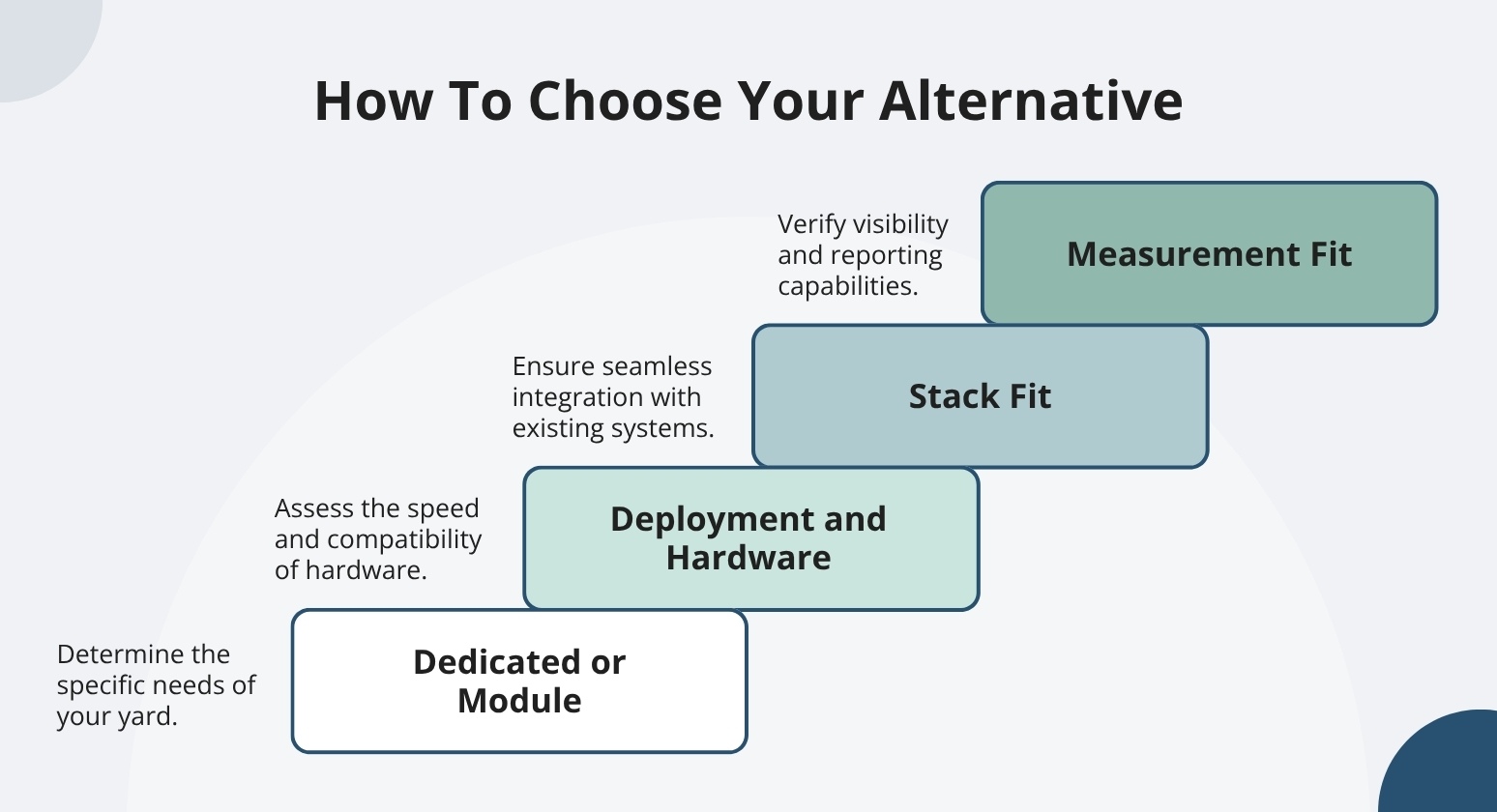
The right pick comes down to a few questions about your operation:
- Decide Between a Dedicated System and a Module: If the yard is your problem to solve, a dedicated system like YardView, C3, or Terminal goes deeper on gate, yard, and dock than a module inside a warehouse suite.
- Weigh Deployment Speed and Hardware: Ask how fast each option goes live and whether it depends on proprietary hardware. Reusing existing devices and automating the yard in software keeps both the timeline and the budget in check.
- Check How It Fits Your Existing Stack: Your yard system has to exchange data with the WMS, TMS, or ERP you already run. Confirm the connection methods and effort involved before you commit, since integration is where rollouts stall or succeed.
- Match It to How You Measure the Yard: If you run a multi-client 3PL or a multi-site network, confirm the system gives you the visibility and rollups you report on. What a 3PL should look for in a yard system is a useful lens even for single-site teams, because it centers on proving the work with data.
The right modern API-driven architecture should integrate seamlessly with your existing WMS or ERP stack.
Move Your Yard Into a Unified View
If the yard is the job you are hiring for, a dedicated system is usually the simpler answer than a module inside a large suite. YardView runs gate, yard, and dock on their own and connects to the systems you already have, so you get yard-grade depth without an enterprise-scale rollout:
- Dedicated yard platform: Gate, yard, and dock built as the whole product, not a warehouse add-on.
- Fast, hardware-light deployment: About six weeks to live, roughly an hour of training, no proprietary hardware.
- Drag-and-drop visibility: A live map with up to 20 data points per asset, plus directed parking and move rules.
- Detention and dwell control: Real-time tracking with threshold alerts and audit trails for disputes.
- Works with your stack: Integrates with any WMS, TMS, or ERP, so the yard fits what you already run.
Explore how YardView compares as a dedicated alternative to a yard module inside a larger suite, and where it fits your operation.
Frequently Asked Questions
What Is the Best Blue Yonder YMS Alternative?
For most teams that want a dedicated yard system, YardView is the strongest alternative and the highest-rated option here, at 4.9/5 on Capterra. The best fit still depends on your stack: SAP or Oracle shops may prefer their native module, and multi-modal enterprises may want Kaleris.
Why Do Teams Look for a Blue Yonder YMS Alternative?
Blue Yonder runs the yard as a module inside a large warehouse and supply chain suite. Teams seek alternatives when implementation runs long, cost outgrows what a yard project can justify, or the module cannot flex to how a specific yard actually works.
Is a Dedicated YMS Better Than a Yard Module in a WMS?
For yard-specific depth, usually yes. A dedicated YMS focuses entirely on gate, yard, and dock, so features like directed moves, dwell tracking, and in-cab tasking go deeper. A module is a better fit when you want the yard native to an ERP you already run.
Do These YMS Alternatives Publish Pricing?
Rarely. Enterprise yard software is almost always quote-based rather than publicly listed, since cost depends on sites, volume, and integration. Compare deployment speed, hardware needs, and fit with your existing stack, then request quotes from a shortlist built on those factors.