Key takeaways:
- Inefficient manual processes rank as the top yard challenge at 40.3%, yet 51.0% of operations add overtime at peak while only 34.2% turn to technology instead.
- Mismatched vendor offerings block 36.2% of buyers and 24% say software lacks needed functionality, so naming one measurable problem decides whether scheduling, a full YMS, or automation fits.
- Implementation effectiveness is the top satisfaction driver at 55.7%, and YardView answers it with a phased rollout that mirrors existing processes, finishes in six weeks or less, and trains users in under an hour.
- Internal capacity is the top adoption barrier at 48%, so baseline KPIs covering detention spend, dwell time and time on site should be captured before go live to measure ROI.
Many yards still run on radio calls, spreadsheets, and scheduled yard walks, and the trailer count is out of date soon after each walk ends. When that happens, drivers can lose part of a shift looking for trailers. Gate and dock flow can slow down too.
This guide will help you and your team decide what to require in a yard management system, compare vendors on fair criteria, and plan a deployment that keeps the yard running.
What Is a Yard Management System?
A yard management system (YMS) is software that monitors and manages vehicles, trailers, containers and inventory in the yards of warehouses, distribution centers and plants. It covers the work that happens between the front gate and the dock door.
Core functions include gate check-in, dock appointments, loading and unloading, seal verification and reefer monitoring. Each one replaces a clipboard, a radio call or a guess.
A complete system does more than book dock slots. It pairs real-time visibility with planning and execution. That means moves get directed to drivers, and KPI reports show how the yard is performing. Dock scheduling is one part of the job, not the whole thing.
A YMS also sits between transportation and the warehouse. It works alongside your transportation management system (TMS) and your warehouse management system (WMS). To do its job, it needs to connect to both.
Which Problem Are You Solving: Basic Scheduling, a Full YMS, or an Automation-Heavy Platform?
Start with the problem you can name and measure. The right tier depends on what hurts most, and buying too much or too little is a real barrier. Basic scheduling and self-check-in fit yards whose main pain is uncoordinated arrivals.
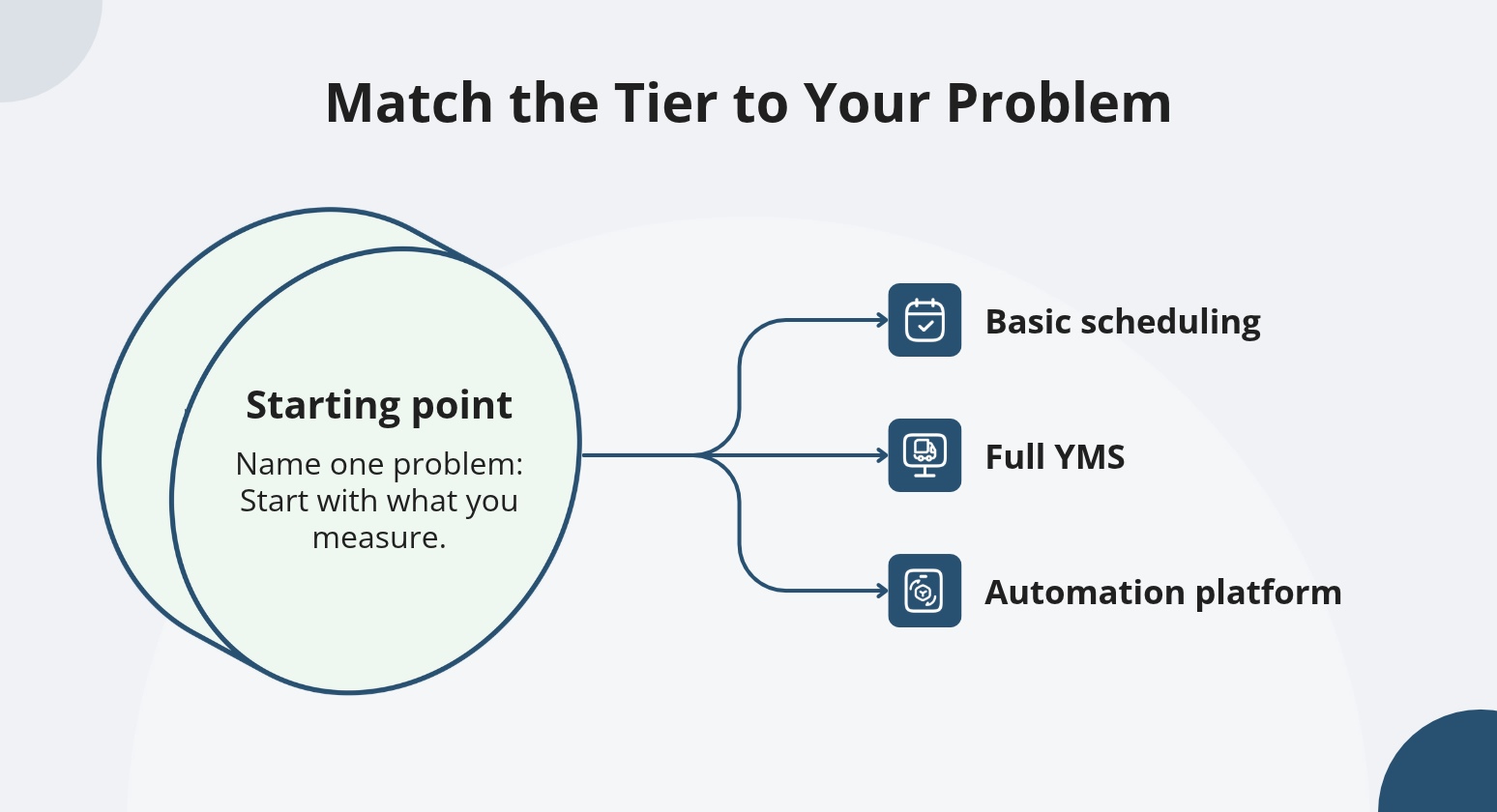
If trucks show up whenever they like and the gate backs up, booking slots and letting drivers check themselves in may be all you need.
A full YMS fits yards that lose trailers, run up detention or can't see what's on the lot. It covers gate check-in, yard-wide asset visibility, move requests, and dwell and KPI reporting. If your team spends shifts hunting for equipment, this is usually the tier to look at.
An automation-heavy platform adds real-time location tracking and a rules engine that sends moves to hostler tablets. Some sites may also look at autonomous yard trucks. It suits very large, high-volume yards.
The tiers aren't exclusive. Many buyers start with scheduling or a core YMS, prove the value, and add automation later.
Defining Your YMS Requirements
Defining requirements is where many YMS projects get stuck. Before you talk to any vendor, settle two things. First, what the system must do for your yard. Second, what it has to connect to. The two parts below take those in turn.
Core Capabilities to Require
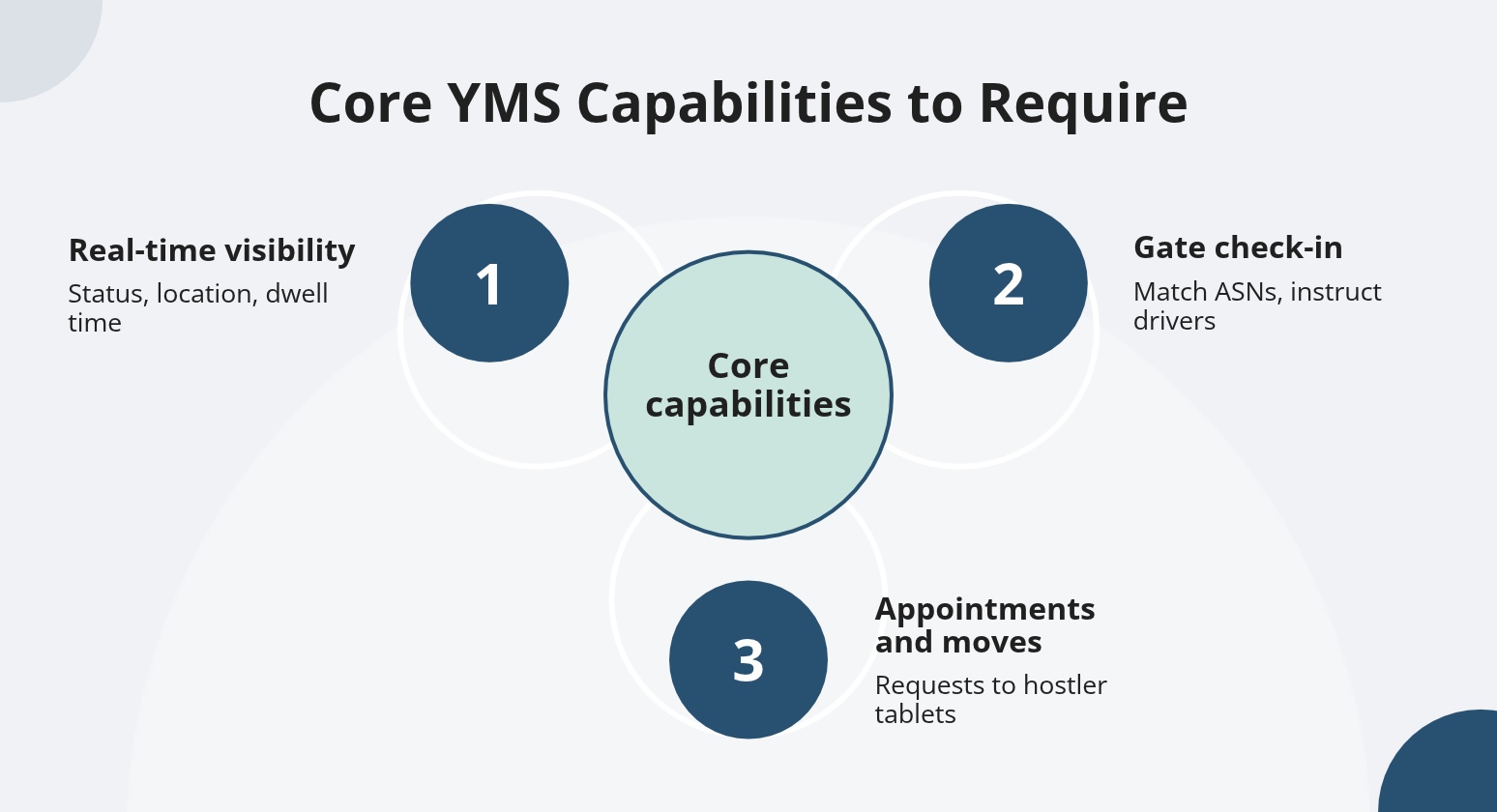
Start with real-time visibility. A count from a yard walk is stale the moment the walker heads back inside. Trailers move, doors turn over, and the sheet no longer matches the lot.
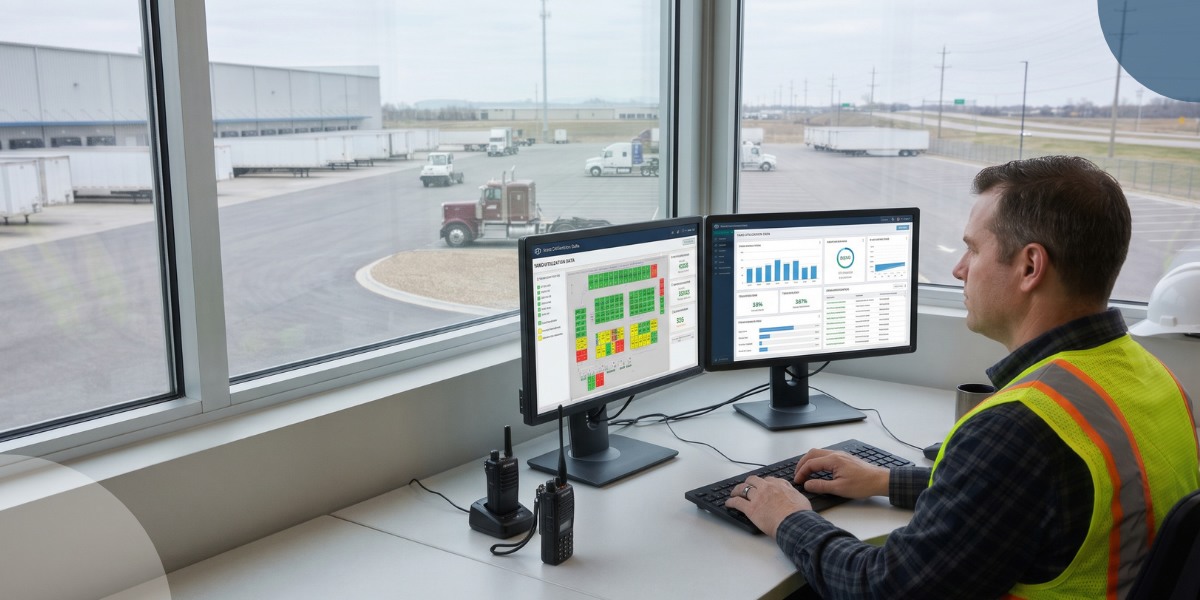
YardView's drag-and-drop yard console shows each asset's status, location and dwell time live across docks, yard spots, in-transit lanes and waiting zones.
Watch: YardView's Drag-N-Drop yard map #YMS #supplychain
Next, gate check-in. Require matching against advance shipment notices (ASNs), so the system can give drivers parking and pick-up instructions on arrival. Self-check-in and mobile apps are in high demand, so ask for them.
Add dock appointment scheduling. Pair it with rules-based move requests sent to hostler tablets, so drivers aren't waiting on the radio for the next job. Then require reporting on dwell time and other KPIs. One Continental Tire deployment used move request, appointment and KPI tools together.
Don't skip usability. Yard staff turn over, so the system has to be easy to pick up. That same deployment set a goal of staff learning it in under one hour.
For large or complex yards, add real-time location tracking (RTLS). It gives exact, continuous asset location when a lot is too big to trust to check-in data alone.
Integration and Data Standards
Integration deserves its own line in your requirements. It's a rising buyer priority, and buyers often struggle to find a platform that fits their existing stack and scale. It's also a common adoption barrier.
Standards give you something concrete to ask for. GS1 publishes a standard for confirming pick-up and drop-off appointments, with guidance for XML and EDI messaging. Check which version is current before you write it into a requirement.
Load tenders come next. The X12 204 tender and 990 response should be implemented before status, billing and remittance, so those later steps can be matched to the tender. Changes go through updated tenders, not side messages.
YMS Evaluation Criteria: How to Compare Vendors
Vendors come in a few forms. Some are dedicated yard specialists. Others offer a yard module inside a broader supply chain suite. A specialist often goes deeper on yard work. A suite module may fit better with the systems you already run.
Weigh that trade-off against your own yard before you score anyone.
Then score every vendor on the same list. Put implementation effectiveness first. It's the top satisfaction driver ahead of ease of use, features and support. After that, check these:
- Configurability over time: can your team change rules as the yard changes?
- Scalability across sites: does it work at your biggest yard and your smallest?
- Integration fit: does it connect to your TMS, WMS and ERP?
- Tier fit: does it match the problem you chose, whether scheduling, a full YMS or automation?
Plan for the barriers too. Budget is the most common selection barrier. Lengthy decisions and mismatched offerings follow. Lack of internal alignment is also often an issue. Get operations and IT agreeing early, and set a decision date.
Finally, treat ROI figures from case studies as a starting point. Confirm them with customers whose yards look like yours. Then test them against your own baseline.
Demo Verification and Questions to Ask Providers
A demo only tells you something if it runs on your work. Ask each vendor to walk through your real workflows, not a canned script. Send them a few sample loads and your own yard layout ahead of time.
Here's what to watch for:
- Check-in with ASN matching: does the system pull the shipment notice and give the driver a parking and pick-up instruction?
- Appointment booking: can a planner book, move and confirm a slot in a few clicks?
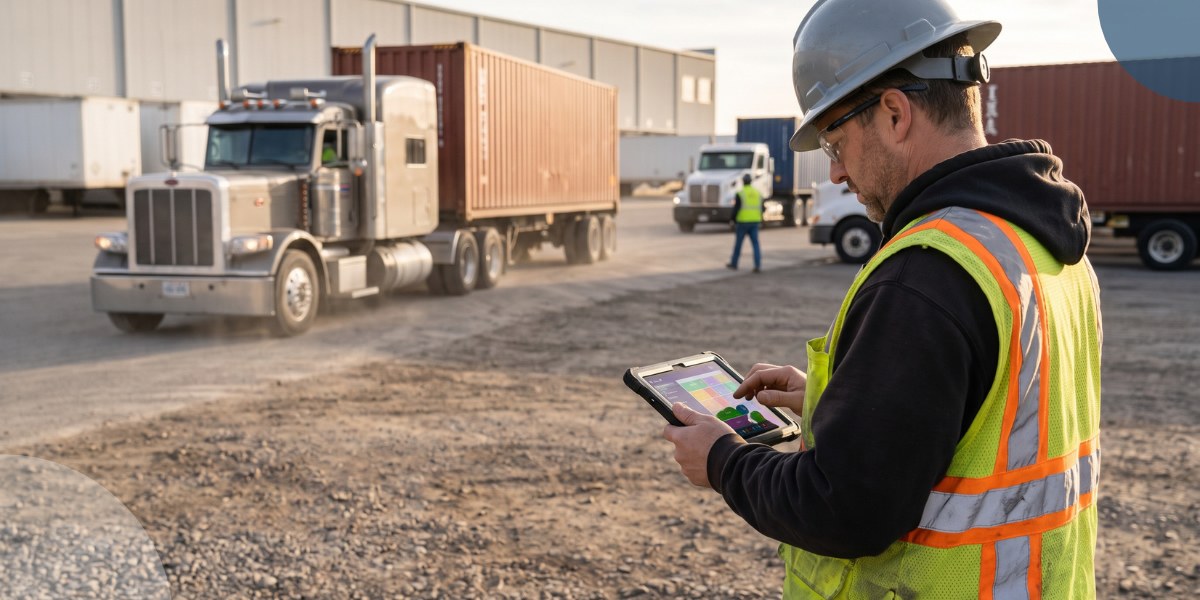
- Move requests: does a request reach a hostler tablet, and can the driver close it out in the cab?
- The KPI dashboard: can you see dwell time and time on site without exporting a file?
Then ask direct questions.
- Can you show proof that it connects to our WMS and TMS?
- Does it support standard 204 and 990 load tender messages?
- Which customers have a yard like ours in size and volume? What were their timelines and measured results?
- How do you handle training, staff pushback and a phased rollout?
YMS Deployment Models: Hosting, Suite or Standalone, and Sensor-Enabled
Deployment choices fall along three lines: where the software runs, how it's packaged, and whether it relies on sensors.
Hosting comes first. Cloud adoption is one of the leading market trends, alongside IoT sensors, AI/ML and better WMS and TMS integration. Cloud-based software means less to install and maintain at each site.
Packaging comes next. A standalone specialist is set up on its own and then connected to your WMS and TMS. A module inside a broader supply chain suite shares data with the rest of that suite, so integration may be lighter. Deployment follows the same split.
Then there's the hardware question. Software-only deployment covers gate check-in, appointments and driver-directed moves. Sensor-enabled deployment adds real-time location tracking and a rules engine. That tends to suit very large yards.
Automation-heavy options, such as autonomous yard trucks, are only starting to reach commercial use.
YMS Implementation and Rollout Considerations
Start by looking at your own capacity. Internal capacity is the top adoption barrier. Ask who will own the project, who will train drivers, and how you'll bring carriers along.
Phase the rollout. Start at one site, prove the value, then expand. Continental Tire began at one distribution center and grew once value was shown.
Plan for what you're replacing. Home-grown tools and clipboard-and-radio routines hold a lot of unwritten habits. NYK Logistics replaced a home-grown system and clipboard-and-walkie-talkie tracking. It ended up with 100% accurate location data, and it went live in 75 days.
YardView rolls out in phases. The first phase mirrors your existing trailer lifecycle in the web-based system, with an hour or less of training. Later phases connect your WMS and TMS, then look at options such as barcoding or GPS.
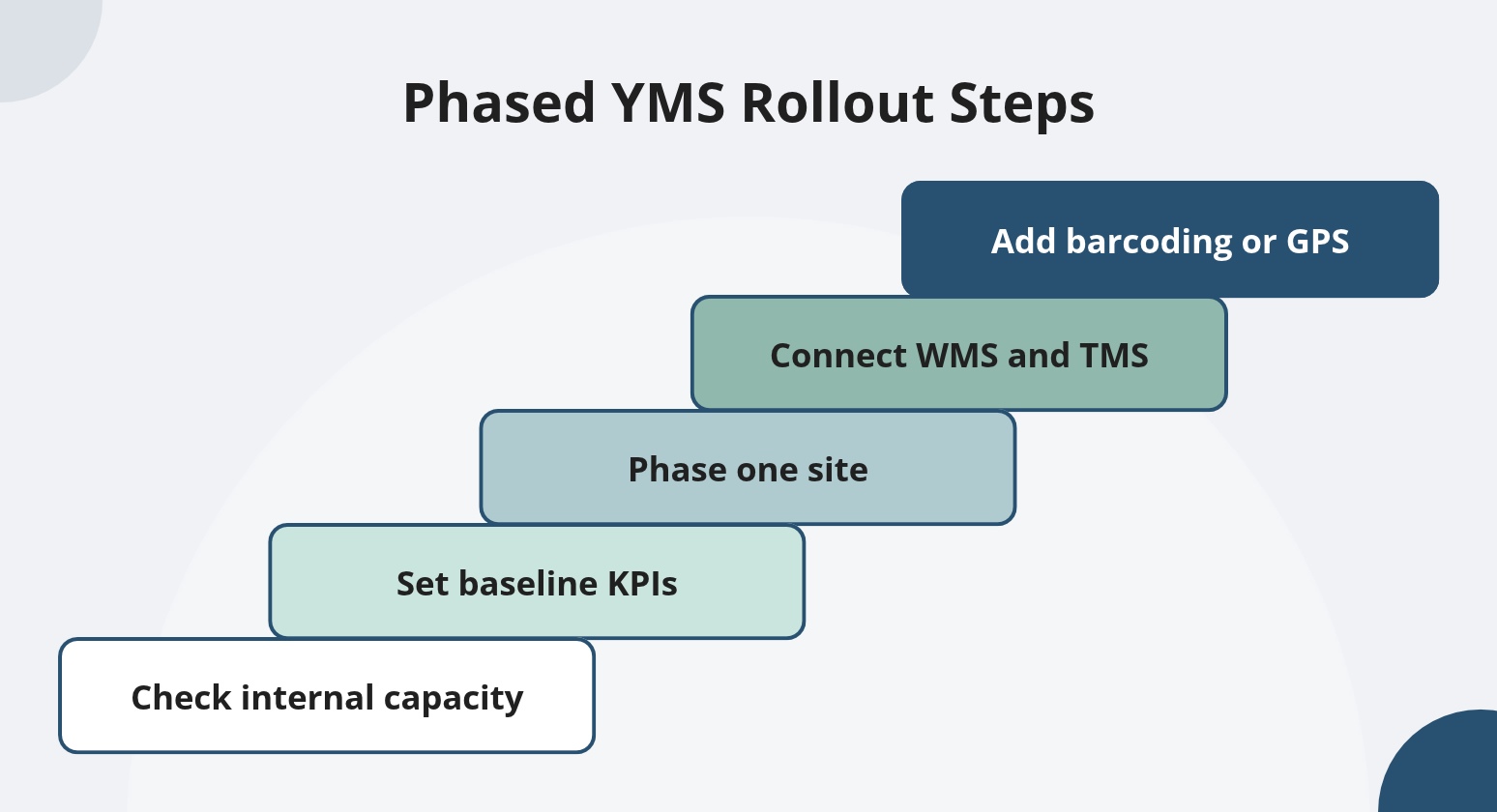
Set baseline KPIs before go-live. Capture detention spend, dwell time and time on site, so you can measure ROI later.
Finally, get operations and IT agreeing before you start, and keep checking in during deployment. Without that, a good system can sit unused.
Put Your YMS Shortlist to the Test with YardView
Working through requirements, deployment models and evaluation criteria is only useful if a platform delivers on all three at once, and that is where YardView earns a place on the shortlist: a web-based yard management platform from Cypress Inland Corporation covering gate, yard and dock scheduling in one system, delivered as single-tenant SaaS on Amazon Web Services so each customer gets a dedicated database and application instance.
- Deployment model clarity: Software-as-a-Service hosted on AWS with single-tenant architecture, giving data isolation and room to customize without affecting other customers.
- Gate flexibility: Manned, unmanned and touchless configurations supported through AI cameras with OCR, QR code scans from drivers' own devices, kiosks, ELD integrations and GPS geofencing.
- Appointment coverage: Inbound and outbound dock scheduling with customizable time slots, dock types and capacity rules, plus carrier self-scheduling against real-time availability.
- Driver tasking built in: An in-cab Accept, Start, Finish move workflow with next best move recommendations based on mapping, proximity, urgency and request age.
- Audit-ready records: Every transaction stored with a full audit trail of what happened, when and who did it, supporting detention and demurrage reconciliation against carrier invoices.
See how YardView measures up against the criteria you have built for your own yard.
Frequently Asked Questions
How Long Does It Take to Implement a YMS?
Implementation time depends on scope. Yard size matters, and so do the number of integrations with your WMS and TMS. Adding sensors like RTLS lengthens the work. One large yard with RTLS went live in 75 days.
A phased rollout across several sites takes longer, since each site adds its own setup.
Should You Build or Buy a Yard Management System?
Buying usually makes more sense, since home-grown systems tend to get outgrown. NYK Logistics replaced its own system and clipboard tracking with a commercial YMS. Weigh your internal IT capacity, which many operations lack. Also count the ongoing work of maintaining a custom build.
Do You Need RTLS with a YMS?
No, RTLS isn't always needed. It adds exact, continuous location data, and that pays off in very large, high-volume yards. Smaller yards can often work well with software-based check-in and driver-directed moves. Start with the problem you can measure, then decide if tracking is worth adding.
Are Autonomous Yard Trucks Ready for Commercial Use?
Autonomous yard trucks are moving from pilots to first commercial deployments, but it's still early. A first deployment went live in Texas in 2024, and another was planned for the second half of that year. The installed base is forecast to grow at a 104.4% CAGR.